Tags
Aynur Haşhaş, deyiş, Edip Harabi, Latife, mahlas, Melûli, Translation
 Aşık Melûli is surely one of the master Alevi poets of the twentieth century. Indeed his life spans nine decades of the century. Born in 1892 his real name was Karaca and was educated both by an Arab hoca and for a decade in an Armenian school in Afşin. As well as his mother tongue Turkish he spoke Arabic, Armenian, Farsi and Ottoman Turkish. He died in 1989 aged 97. The poem here bear’s the mahlas of a female persona, Latife, remarkable strategy Melûli used as early as 1947, to transcend gender roles and express his concept of the sacredness and creative power of women. (See the book by Özpolat and Erbil cited below, p. 449.)
The poem is fairly straightforward in regards to translation, although difficult choices are necessarily made that colour the interpretation of the translation. One of the challenges is whether or not to translate ‘Pir’. I have a strong inclination to leave such terms untranslated since they carry so much culturally specific meaning. It has the sense of teacher, master, saint, guide and the head of a dervish order. In this version I have however committed a translation, opting for ‘Dervish’ which I expect to carry various connotations for the reader in English. The use of the word ‘Pir’ is just one expressive element that points to a mystical reading; yet one of the great characteristics of the song, particularly emphasised by the choice of mahlas, is the possible wordly interpretation. It is certainly this position that can be seen in Aynur Haşhaş’s recording while performed to the classic Alevi melody she replaces ‘Pir’ with the more ambiguous terms ‘canım’ and ‘yar’.
There is no doubt this lyric is provocative and forthright. Latife does not avoid the language of religion saying her Kabaa (Mecca) is the tavern (meyhane). She dismisses the intolerant as ‘barking guard dogs’ (kelb rakibin ürümesi). I have tried to render the implied intimidation of the latter line with the idea of ‘patrolling hounds’.
A word should be said about the form of the mahlas ‘Latife’m’ which perhaps should read ‘my Latife’. However, convention suggest that the mahlas is not understood as a possessive construct but an expression of person (be it first, second or third). So forms such as this are understood to be a contraction of the first person verb to be, that is ‘Latife’yim’.
I should also note that we are fortunate to have an excellent introduction in English to Melûli by Hans-Lukas Kieser in his book chapter titled: Alevilik as song and dialogue: the village sage Melûli Baba (1892-1989). Kieser reveals Melûli as a remarkable figure of provincial ‘enlightenment’ in the late Ottoman period. The principal source for Melûli’s life and work and from where my text comes from remains the book Melûli divanı ve Aleviliğin tasavvufun Bektaşiliğin tarihçesi by Latife Özpolat (herself) and Hamdullah Erbil.
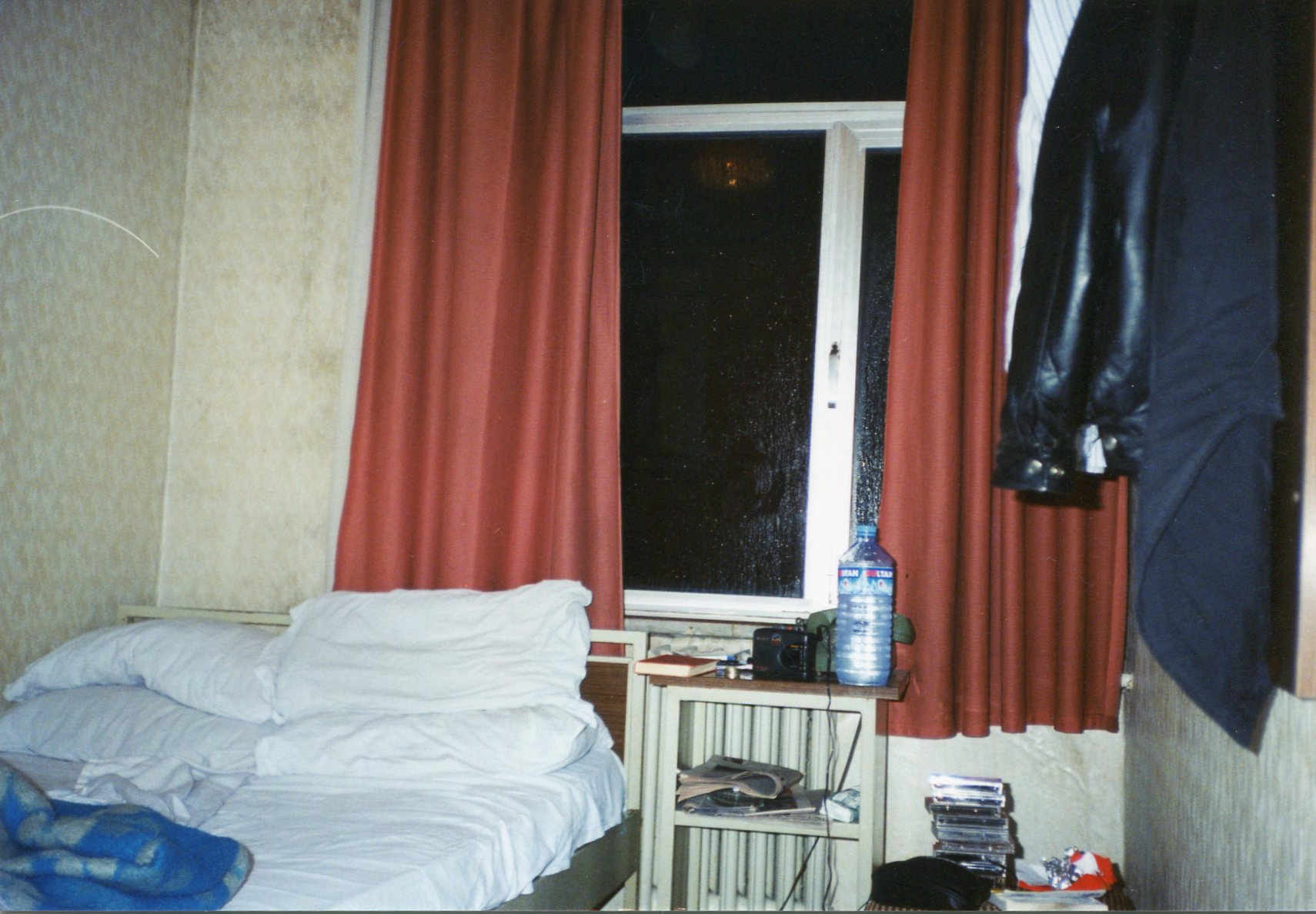
Postscript: a note and reminiscence on the picture. I generally try to use pictures from my travels in Turkey that have some tangential (and not always obvious) connection to the text. That may be true of this picture too, but it is also a small nostalgic reflection on fondly remembered friendly cheap workers’ hotels that could be found in Sirkeci in the 1980s and early 1990s. Now sadly replaced by poorly gilded (and much more expensive) tourist hotels. This was a room in one of my favourites, the original (and long departed) Otel Fahri on İbni Kemal Cad. when it was a quiet street (photo taken in early 1995). On one occasion, perhaps the time this photo was taken, there was a night time tavern restaurant around the corner squeezed in on Ebussuut Cad. near the corner of Ankara Cad. where gypsy musicians from Şişli would pass through – with much jolity, bonhomie and much drinking of rakı. When I visited the following year the tavern was gone, without trace (like something out of Robert Irwin’s Arabian Nightmare – but that is another story) and Necmettin Erbakan was Prime Minister. I am not necessarily drawing a connection, but the belly dancer on the İbo Şov – Tatlıses is the great ‘Vicar of Bray’ of Turkish culture – also disappeared at this time, as I recall. The eagle-eyed will notice some travelling essentials in the picture – bottle of water (none other than ‘Sultan Su’), chocolate, cassette walkman – remember those! – leather jacket, tissues and book which, if I must own up, was an old edition of John Buchan’s Greenmantle that, as is my practice, I donated to a hotel draw somewhere down the track in eastern Turkey).
Latife Bacı: Mey içtim sarhoşum bugün
Translation: Paul Koerbin
Today I drank wine and was drunk
I swear, I cannot hold my tongue
Today I was so pleased with my Dervish
I swear, I forgot all about death
The world appears completely empty
My Dervish brings me pleasure
He is exuberant whenever he loves
I swear, I love my Dervish
The morsel the Dervish proffers is permitted for me
The tavern is my pilgrim’s kabaa
The barking of the patrolling hounds
I swear, does not block my way
Let the Dervish come and be cross with me
Let my arm embrace his neck
Let the arms that are drawn away be broken
I swear, I cannot withdraw my arm
If I enter his embrace uncovered
If he sleeps and I love silently
If he awakes and he speaks rudely
I swear, I cannot withdraw my hand
I am Latife I am so shameless
I love greatly and I am so brazen
I know nothing of shame and honour
I swear, I will pluck my rose
———————————————————————————————–
Original Turkish text from Melûli divanı ve Aleviliğin tasavvufun Bektaşiliğin tarihçesi by Latife Özpolat and Hamdullah Erbil (2006)
Mey içtim sarhoşum bugün
Tutamam dilim vallahi
Pir’imle çok hoşuma bugün
Unuttum ölüm vallahi
Dünya tümden boş geliyor
Pir’im bana hoş geliyor
Her sevdikçe cüş geliyor
Severim Pir’im vallahi
Helal bana Pir lokması
Hacc-ı kâbem meyhanesi
Kelb rakibin ürümesi
Kesemez yolum vallahi
Varsın banan Pir darılsın
Kolum boynuna sarılsın
Çözülen kollar kırılsın
Çözemem kolum vallahi
Girsem koynuna gömleksiz
Uyusa ben sevsen sessiz
Uyansa dese edepsiz
Çekemem elim vallahi
Latife’m çok hayâsızım
Çok severim çok yüzsüzüm
Ar namus yok habersizim
Çalarım gülüm vallahi
 This deyiş appears in Ergun’s 1929 collection of Pir Sultan’s lyrics and again in Gölpınarlı and Boratav’s 1943 edition where the source is given as Ergun, although with a couple of slight changes. In the first line of the 4th verse Ergun has Mağripte (Mağrib = Magreb, the West) while Gölpınarlı/Boratav give Meydana; and in the 3rd verse Ergun has küçük gazili while Gölpınarlı/Boratav have köçek gazili. The version used for my translation is from Memet Fuat (1999 reprint edition) who follows Ergun in regards to Mağripte (well almost, since he has the ablative Mağriğtan rather than the locative) and Gölpınarlı/Boratav in regards to köçek (both versions give the sense of a novice entering the tarikat). This deyiş is a good example of a theme found in the lyrics of Pir Sultan – the hope and expectation of the coming of the Shah, in this case the temporal ruler. It is for such allegiances that the kızılbaş were pursued by the Ottoman authorities. The word Urum refers to the land of ‘Rum’, Anatolia, the Ottoman lands. Three generations of the Safavids are referred to in the lyric (as Fuat notes): Shah Tahmasp is the ‘beautiful leader’ who is expected; and he is the ‘Shah’s son’, that is the son of Shah Ismail, the first Safavid ruler, while ‘Old Haydar’ refers to Ismail’s father and Tahmasp’s grandfather. The mahlas verse reveals that this expectation may be but a wish of Pir Sultan’s.

 This deyiş appears in the all of the earliest collections of Pir Sultan Abdal lyrics, including Besim Atalay’s 1924 publication Bektaşilik ve Edebiyatı (originally in Ottoman Turkish but translated into modern Turkish by Vedat Atila and published by Ant Yayınları in Istanbul in 1991). It also appears in Sadettin Nüzhet Ergun’s 1929 work on Pir Sultan Abdal and in the 1943 publication by Gölpınarlı and Boratav. Comparing these editions is interesting since there are minor variants in the texts – the minor nature of the variants is of itself interesting and perhaps gives a glimpse of how a traditional lyric may be adopted into the Pir Sultan canon. The lyric is not overtly on the central themes associated with Pir Sultan such as the kızılbaş devotion to the Imam Ali (but see below) or subjects associated with his life story; rather it seems closer to Sufi themes and the lyrics of Yunus Emre. The text I have translated is based on that presented in Gölpınarlı and Boratav’s 1943 edition. This seems to be something of composite text, though Gölpınarlı’s method of presenting the texts, while stating sources does not make clear how variants are used. The authors cite the sources as Atalay, Ergun and an undefined number of cönk and mecmua in Gölpınarlı’s possession. The most interesting of the minor variations of text is found in the version presented by Atalay who gives the last line of each stanza as ‘Ali deyu inilerim’ (‘I moan crying Ali’) thus revealing somewhat more overtly the Alevi theme in the lyric. The one line that is different in the three versions cited is the third line of the second stanza which in Gölpınarlı reads ‘Oldum ayn-i cem bülbülü’, in Ergun reads ‘Olmuşam Şah’ın bülbülü’ and in Atalay reads ‘Oldum muhabbet bülbülü’. While the signficance of the line is hardly altered, the approaches ranging from the specific mention of the ritual ceremony (ayn-i cem), to the hoped for Shah and to the general idea of love and unity (muhabbet) is instructive.
 Muhlis Akarsu was prolific in his composition and recordings (in the pre-CD days) and fortunately many have been subsequently released on CD. The more I listen too these recordings, both solo and as part of the Muhabbet series, the more his brilliance is evident. This deyiş is from his last recording prepared shortly before he was killed in Sivas on 2 July 1993. The album was released after the Sivas events with the title Sivas Ellerinda Ömrüm Çalınır which includes the recording of that re-written version of the Pir Sultan Abdal deyiş performed by Arif Sağ (see
 One of the most evocative of Pir Sultan’s lyrics; especially when sung to the beautiful melody with which it is associated.
  PİR SULTAN ABDAL and me