• About Pir Sultan Abdal
  • About the ‘me’ in this blog
  • Index of translations on this blog
  • More translations available in my PhD thesis
  • Regarding the translations on this blog

PİR SULTAN ABDAL and me

~ A personal reflection on the great Alevi poet's lyric works and influence – mostly through translation

PİR SULTAN ABDAL and me

Author Archives: koerbin

Two minor works from Edip Harâbî – one on taking the mahlas ‘Harâbî’ and the other a (slightly vulgar) improvised satire

09 Thursday Jan 2025

Posted by koerbin in Translations

≈ Leave a comment

Tags

Edip Harabi, mahlas, Translation

Ahmed Edip Harâbî (1853-1917) was one of the most important Bektashi poets of the late 19th and early 20th centuries. He is known for his great ‘cycle of existence’ – or devriye – poems such as the one presented and translated by John Kingsley Birge in his seminal 1937 publication The Bektashi Order of Dervishes, beginning (in Birge’s translation):

Before the ‘B’ and the ‘E’ ever appeared

We are the beginning of the universe

Before any became joined to the face (of God)

We are the ‘distance of two bows or closer’

Or his great, long poem the ‘Vahdetname’ – a truncated version (about half) of which was included in translation in Jennifer Ferraro and Latif Bolat’s publication of ‘mystical rebel poems of the dervishes of Turkey’ titled Quarreling with God (Cloud Press, 2007). Both of these works survive with musical arrangments. The ‘Vahdetname’, as performed by Emekçi, was included on the groundbreaking album Kızılbaş prepared by Ulaş Özdemir for Kalan Müzik in 2009; as Özdemir has said, this was an album put together with the idea of initiating a series of albums to present the most ‘radical’ Alevi-Bektashi works yet recorded. (Kalan produced a second Kızılbaş named album in 2011 and in 2014-2015 a follow-up series of two double CDs titled Aleviler’e‘.) Moreover, as Özdemir says, this album “is from beginning to end a political work … [from] the viewpoint of Alevi-Bektashi communities in their everyday lives lives as well as in their faith”. It is weighty with works by Harâbî – as well as the Vahdetname there are two other works by him including the opening track given the title ‘Kızılbaş’ – as well as songs from other hard edged Alevi (Kızılbaş) poets such as Teslim Abdal and İbreti.

Harâbî was known to improvise many of his poems but he did leave behind a large manuscript collection amounting to around 519 poems. Interestingly, he included many brief comments about the context of a number of these improvisations. Harabi’s works range from the mystical to the satirical showing the influence of the greats from Yunus Emre to Pir Sultan to the biting satire of Kaygusuz Abdal. Harâbî is also notable for composing works in various identities including female identities using the names Lutfiye and Zehra Bacı (for more on Harabi’s writing as Bektashi ‘sisters’ see the 2017 paper by Ömer Ceylan titled: “Bektâşî diliye kadın müdâfaası” Edip Harâbî’nin Lutfiye ve Zehra bacılar ağzından yazdığı nefes).

The two works I have translated here are certainly minor works, but interesting in themselves. The first is one that attracted my attention when researching for my PhD on the mahlas – self-naming convention – in Alevi lyric song. In this poem Harâbî refers to his taking of the mahlas Harâbî – even giving dates, making the point that taking the mahlas is a transcendent act that connects to a tradition or master (in this case from Mehmed Ali Hilmi Dede Baba, who we met in my previous post being somewhat disparaged by Vahid Dede for his ‘syrupy’ musical influence). Harâbî includes notes about the dates and numbers in this work, saying this was spoken ‘nutku söylediğim‘ in 1318 [1902], he was born in 1269 [1853], he is currently 49 years of age, he was initiated into the dervish order – nasîb aldığım – at the age of 17 and has completed 32 years as an initiate.

The second poem – an improvised ghazel (or not a ghazel as the title suggests) – is something quite different. On my initial reading it reminded me of Catullus in his personally directed satire and vulgar insult. Such works as this certainly bring to life a real person behind some of the most sublime mystical works and indeed he uses his birth name ‘Edip’ as the mahlas in this poem. Harâbî includes a note to this poem to the effect: ‘said for an errant gentleman as needed’. He also provides a rather cryptic introductory note saying it is a published “improvisation … people who don’t know how to fly prevent flying birds from flying, and some people, the honorable ones, have made the wings of the flying birds fly more than the flying bird, for God’s sake! 12 March 1324 [1906]”.

Edip Harâbî : Peder ve vâlidem oldu bahâne

Translation: Paul Koerbin

My father and mother were the root cause

The restlessness of two oceans meeting

In one thousand two hundred and sixty-nine

Manifest I arrived and came into the world

I was freed from this world and I withdrew

At seventeen years of age from my birth

From Mehmed Ali Hilmi Dede Baba

Let there be thanks, I achieved the possibility

My name was Edip and I became Harabi

I was dust at the feet of the Enlightened

I became an opened book for them

Proclaiming ‘let there be love’ to the Knowing

——————————————————-

Original text from: Dursun Gümüşoğlu, Ahmed Edîb Harâbî Dîvânı: yaşamı ve tüm şiirleri (3rd ed. Can Yayınları 2013), p. 182

Peder ve vâlidem oldu bahâne

Merec-el-bahreyni yeltekıyâne

Bin iki yüz altmış dokuzda kâne

Eriştim zâhiren geldim cihâne

Berzahtan kurtuldum çıktım aradan

On yedi yaşında doğdum anadan

Mehmed Ali Hilmi Dede Baba’dan

Çok şükür hamd olsun geldim imkâne

Nâmım Edip idi Harâbî oldum

Erenlerin ayak türâbı oldum

Anınçün herkesin kitâbı oldum

Aşk olsun okuyan ehl-i irfâne


Edip Harâbî : Gazel değil Hazel

Translation: Paul Koerbin

Oh Kamil Efendi, why do you act so foolishly?

You go awry abandoning the right path

If your jacket is torn and button on your pants snaps off,

And you can’t find thread, with what would you stitch it?

If you have a secret place, fine, or if perhaps you don’t,

If you find a jenny, where would you screw it?

You can’t appreciate this poem being a small gem

And now you pervert this true word

You’ll destroy the garden of the perfect one

Is it apt, Edip, so you sow the seed of forgetfulness?

—————————————————————

Original text from: Dursun Gümüşoğlu, Ahmed Edîb Harâbî Dîvânı: yaşamı ve tüm şiirleri (3rd ed. Can Yayınları 2013), p. 483

Ey Kamil Efendi neye çahillik edersin

Doğru yolu terk eyleyerek eğri gidersin

Yırtılsa caket pantolonun düğmesi kopsa

İplik bulamazsın anı sen neyle dikersin

Gizli yeriniz varsa güzel, yok ise şayet

Bir kancık eşek bulsan onu nerde düzersin

Bu şi’ir-i güher paremi takdir edemezsin

Bu doğru sözü şimdi de sen eğriye çekersin

Kamil olanın tarlasını mahv edeceksin

Layık mı Edib böyle nisyan tohumu ekersin

Secret Turkish folk music – Vahid Dede on Alevi music

02 Thursday Jan 2025

Posted by koerbin in Uncategorized

≈ Leave a comment

Tags

Alevi music, Translation, Vahit Lütfi Salcı

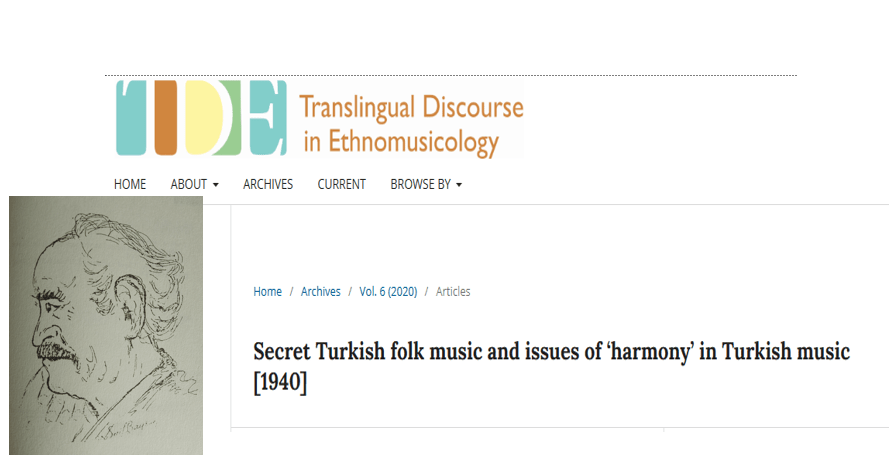
In the 1940s the Bektaşi poet, musician and scholar Vahid Lütfi Salcı published two short seminal monographs on Alevi music and culture. In 1940 he published Gizli Türk halk musikisi ve Türk musikisinde (armoni) meseleri (Secret Turkish folk music and the issues of ‘harmony’ in Turkish music) and in 1941 Gizli Türk dini oyunlar (Secret Turkish religious dances). In 2020 I published a translation of the first of the monographs in the journal Translingual Discourse in Ethnomusicology. That journal, which sadly now seems to have ceased publishing new issues, was a wonderful initiative of the Department of Musicology at the University of Vienna, aimed at encouraging discourse across language barriers by publishing English translations of important ethnomusicological works published in other languages and which may not have received as wide attention as desirable.

The work by Vahid Dede is important in many ways, not least for establishing the concept of Alevi music as a ‘secret’ or ‘hidden’ (gizli) part of Turkish folk music. It was the first substantial publication to focus on Alevi music per se and is all the more important since Vahid Dede was himself a Bektaşi and therefore writing with something of the authority of an ‘insider’. The work also aims to address what Vahid Dede refers to as misinterpretations of some earlier works of his – therefore this longer work to set the record straight. He argues that the music of the Bektaşi lodges has been corrupted by a “syrupy” urban, oriental style, particularly that as promulgated by Mehmet Hilmi Dede Baba; while the lost noble and dignified musical and performance character is still discernable in Alevi folk music. The publication includes musical examples and lyric examples from a number of poets including Harabi and Seyrani; and two lyrics from Pir Sultan Abdal (Gel güzelim kaçma bizden and Gelmiş iken bir habercik sorayım).

My translation and Vahid Dede’s original text are available in Volume 6 (2020) at the Translingual Discourse in Ethnomusicology website.

Meanwhile, I will include below my short “translator’s note” from the publication.

Translator’s note

At the beginning of the 1940s, the Istanbul-born poet, musician, teacher and scholar
Vahid Lütfi Salcı (1883-1950) published two monographs on Alevi music and
mystical dance (semah) – no more than short pamphlets – the first such monographs
in republican Turkey. The earlier of those two monographs is presented here in
English translation. Salcı’s studies promoted the concept of Alevi musical culture as
Turkey’s ‘secret’ folk music, although they were not in fact the first works to do so.
Salcı himself published several articles in the 1930s on Turkish folk music and Alevi
culture, including a substantial study in 1938 in the journal Ülkü Halkevi Dergisi
titled ‘Gizli Halk Musikisi’ (‘The Secret Folk Music’). Prior to this, the French
musicologist Eugene Borrel in 1934 published a paper in the Revue des
Études islamiques
titled ‘Sur la musique secrète des tribus Turques Alévi’ presenting
similar conclusions (and in some parts similar descriptions) to Salcı’s later work. As
Borrel acknowledged, his work was largely influenced by materials supplied to him
by Salcı and by what he described as ‘un sensationnel article’ – referring to Salcı’s
series of articles on polyphonic folksong and harmony in folk music, published in
1933 in Milli Mecmua. Being Bektashi – he was also known as Vahid Dede – and
growing up with a forthright Alevi mother who rejected the offer for her son to study
as a hafiz (his father died when he was young), Salcı was well placed to gain access to
the secret rituals of Alevis and Bektashis as he travelled widely throughout Anatolia
and subsequently lived and worked in Thracian Turkey, particularly around Kırklareli.
As Salcı makes very clear in the work presented here, his purpose in publishing the
monograph is in no small part polemical. Firstly, it was to set the record straight
regarding ‘secret folk music’ and the issue of harmony in Turkish music, identifying
misinterpretations of his earlier works by those unqualified or without access to
materials. Secondly, it was a cri de coeur from the era of the newly established
Turkish Republic and following the period of Turkish language reform for the need to
abandon Ottoman music – which he recognised as beloved but also as a hindrance to
the young republic’s progress, reputation and place in the western world – in favour
of Turkish folk culture, particularly the pure expression of it found in the secret music
of Turkish Alevi tribal groups. In this context, Salcı calls for systematic action in
collecting folk material generally, especially the secret music culture of village
Alevis. The study itself is frequently rhetorical, with excursions into the description of
ritual (specifically that of the sofra feast and communal muhabbet gatherings); it also
presents some musical and textual materials, including examples from at least ten
lyric poems, together with some rather perfunctory analysis. In keeping with the
rhetorical purpose of the study, the language moves from the succinct and imperative
to the lyrical and prolix, providing significant challenges for the translator – a task not
helped by a number of printing and typographical errors in the original.

Paul Koerbin

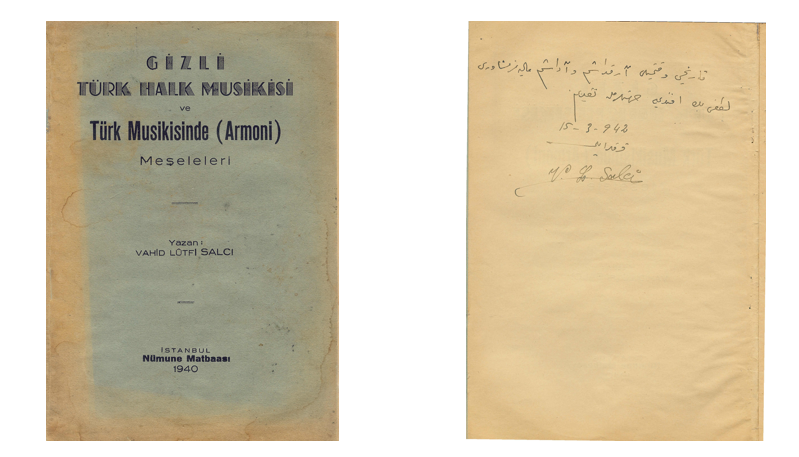
The original 1940 publication and autograph by Vahid Lütfi Salcı (from my personal collection).

The sketch of Vahid Dede included in the image at the top of the post is taken from the book Vahit Lütfi Salcı’nın izinde by Mevlüt Yaprak (Ulusal: Edirne, 2003).

Pir Sultan Abdal ‘Gam elinden benim zülfü siyahım’

12 Thursday Dec 2024

Posted by koerbin in Translations

≈ Leave a comment

Tags

Ahmet İhvani, Aşık Daimi, Feyzullah Çınar, Gölpınarlı, Gevheri, Pertev Naili Boratav, Ruhi Su

Exif_JPEG_420

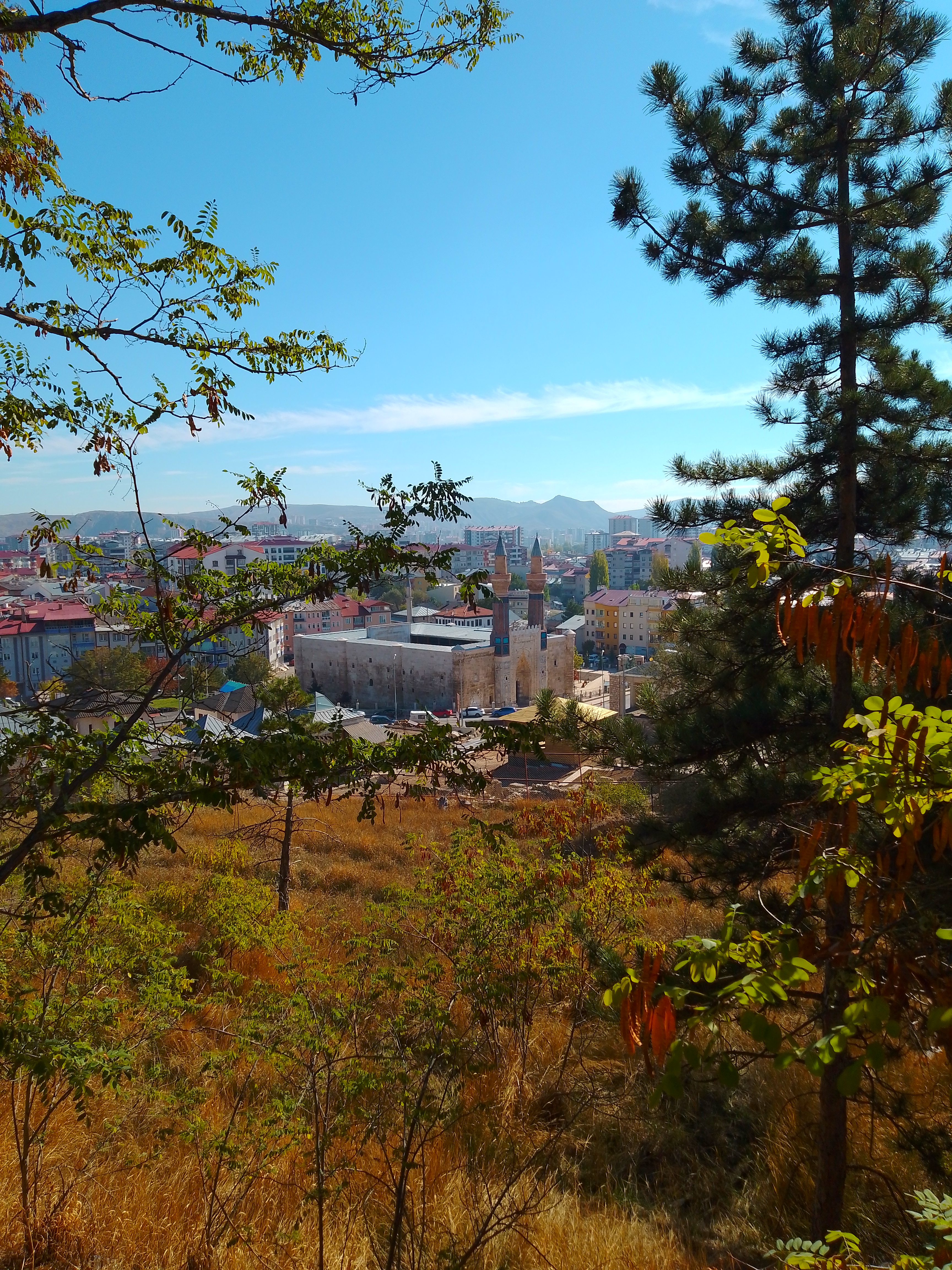
Gök Medrese from Sivas Kalesi (October 2024)

This text first appears in the Sadettin Nüzhet [Ergun] 1929 publication of Pir Sultan Abdal texts. This is the main text I have followed for the translation although I have also referred to the 1943 publication by Gölpınarlı and Boratav which reprints Ergun’s text with some minor, mostly orthographical, changes. In fact, this text persists with very few variants. Most notable is the use of ‘teşevvüştür‘ for ‘neşterlidir‘ in the 4th verse. I have also seen a version of this verse that replaces ‘gün gelir geçer …’ in the second line with ‘gürler gelir geçer …’. The idea of gürlemek, to thunder or make a loud noise, together with the original sense of passing days has influenced my translation towards the idea of ‘croaking’ – for better or worse. The word ‘can’, simple, manifold and profound, always presents a challenge and frustration as it is impossible to convey the full depth of meaning – while also, for the same reasons, it gives the translator considerable interpretive scope. The song is a great cris de coeur emphasised by the repetition of the vocative gel – come! – at the end of each verse. As Gölpınarlı and Boratav note, this rhyme recalls a similar use by Gevheri (died early 18th century), for example in the lyric (originally published by Köprülü in 1929) beginning: ‘Ne nihan edersin benden yüzünü / Hasretinle hâlim yaman oldu gel / Hak aşkına olsun göster yüzünü / Görmedim cemâlın zaman oldu gel‘ (see M. Fuad Köprulü, Saz Şairleri I-IV. Akçağ, 2004. p192-193). 

The song has been recorded by some of the great Alevi musicians including Feyzullah Çınar and Aşık Daimi as well as ‘urban’ interpreters such as Ruhi Su and Rahmi Saltuk. Recorded versions of the song closely follow the original text although usually with the omission of the 4th verse (as in the case of Feyzullah Çınar and Ruhi Su) or both the 3rd and 4th verses (as in the case of Aşık Daimi and Ahmet İhvani). Interestingly (for me at least) Aşık Daimi reverses the form of the mahlas from “Pir Sultan Abdal’ım” to “Abdal Pir Sultan’ım”. The form of the mahlas is something I have written about at length elsewhere. A notable version available on YouTube is that by the Canadian based Alevi musician Ahmet İhvani in a masterful performance incorporating the ‘Deli Derviş’ bağlama instrumental work as a prelude to the song. 

Pir Sultan Abdal: Gam elinden zülfü siyahım

Translation: Paul Koerbin


Grief from your hand, my divine beauty,

Struck like an arrowhead wounding my heart – Come!

Don’t make me weep for your great wound

Today love was split from the soul – Come!

My native home became a fortress of sorrow

My cry unheard my prayer unheeded

My woe not one, not five, nor ten

But come upon as knots upon knots – Come!

Shall I thus be bound to longing?

Did Leyla endure for Mecnun?

The world is transitory – come, don’t begrudge me

My burden of chattels let for pay – Come!

Whatever my pained heart suffers it bears no scar

Then one croaks and life is never fulfilled

Old wounds are opened and are never healed

The verdant place has turned to black – Come!

I am Pir Sultan Abdal – in a week in a month

Days come and go and nothing is gained

The heart longs for God – my soul in futile pursuit

My black earth cast in heaps upon me – Come!

————————————————————————————————————

Original text from Sadettin Nüzhet [Ergun], XVII inci asır Sazşairlerinden Pir Sultan Abdal Bütün Şiirleri (1929)


Gam elinden benim zülfü siyahım

Peykan değdi sînem yaralandı gel

Suna başın içün ağlatma bizi

Bu gün sevdâ candan aralandı gel

Gamdan hisar oldu mekânım yurdum

İşitmez âvazım dinlemez virdim

Bir değil beş değil on değil derdim

Düğümler baş urdu sıralandı gel

Hasretine vâsıl olam mı böyle

Mecnun’a da bâkî kalır mı Leylâ

Ölümlü Dünya’dır gel helâl eyle

Yüklendi barhanem kiralandı gel

Ne çekerse dertli sinem dağolmaz

Günler gelir geçer ömür çokolmaz

Neşterlidir yaralarım onulmaz

Kökerdi çevresi karalandı gel

Pir Sultan Abdal’ım haftada ayda

Günler gelir geçer bulunmaz fayda

Gönül Hak arzular canım hayhayda

Toprağım üstüme karalandı gel

Interpreting self-naming (‘mahlas alma’) in Alevi songs

26 Thursday Nov 2015

Posted by koerbin in Uncategorized

≈ Leave a comment

Tags

mahlas

Players in the ‘web of poetic tradition’ : interpreting self-naming in Turkish Alevi sacred and secular sung poetry

This paper was accepted for the 43rd International Council for Traditional Music World Conference held in Astana, Kazakhstan, in July 2015. Unfortunately due to unforeseen personal circumstances I was forced to abort my travel en route to Astana and never got to present the paper in person. For this reason I am posting it here. The paper aims to provide a concise overview of my research interests. A PDF version of the paper can be found here: Koerbin_2015_ICTM_paper

Paul Koerbin (Copyright 2015)

“I am Pir Sultan Abdal, here in the world

Is there anything deficient in my word?

Anything lacking in my very self

I came to stand right before you!”

Here is an arresting voice to encounter in a traditional song. How meaning is experienced through such expression of the lyric persona in Alevi sung poetry has long interested me and is the subject of my research.

THESIS

So, let me declare my thesis: that the mahlas – the rhetorical invoking of the poetic persona, by name, to which the song is attributed – is a device of nuance and associative force that contributes to the creative and interpretive vitality of Alevi sacred and secular sung poetry[i].

INTRODUCTORY ANECDOTE

By way of introduction I wish to briefly recount my personal encounter with Alevi songs – collectively designated by the term deyiş. In the early 1980s as a jobbing musician in the genre that would later be characterised as ‘world music’ I became interested in Turkish music while working with Turkish and Azeri musicians. To nourish my growing interest in Turkish music I sought out the Turkish video shops in Sydney and Melbourne and collected many music cassette tapes. The recordings that particularly captured my attention were those rich in Alevi song – particularly the series of Muhabbet recordings and the recordings of Arif Sağ from the mid-1980s. In sound, the songs were affecting in their deep and sober vocal sonority performed to the accompaniment of just, or primarily, the bağlama which was both assured and intricate though restrained. Most strikingly, the songs were dense in lyric content. My initial response was to the sound since without Turkish language skills at the time I did not understand the content of the words. Even Turkish friends, non-Alevis, from whom I sought help in understanding these songs, were usually baffled and unhelpful. However, as I began to teach myself Turkish and find out more about the songs I was most struck by the overt expression of the lyric persona in the form of a declared name of attribution that came as the climax of the lyric – this is the mahlas. At this time I also first encountered the plenitude of publications devoted to the most influential of lyric personas: Pir Sultan Abdal, whose presence will pervade this paper.

For me, as an aspiring performer of these songs, this presented a dilemma that I had not considered before in performing traditional music; and posed certain questions, including:

  • What does it mean to perform songs that invoke attributive personas so manifestly? And,
  • What are the implications for my own performance of these ‘signed’ songs?

My purpose in emphasising my personal performing experience with Alevi song as the impetus to my scholarly interest is to raise the matter of subjectivity in my encounter with, and efforts to understand, Alevi musical culture. Simply put: is my personal experience an insight; and if so how to realise such understanding?

THEORETICAL MODEL

The way forward was provided for me by Timothy Rice’s work expressed in his seminal 1987 article ‘Towards the remodelling of ethnomusicology’ and of course in his major work May it Fill Your Soul published in 1994. Rice’s proposed epistemology provides a pathway to negotiate the antinomy between the objectivity of musicology and the subjectivity of musical experience. His model makes the object of enquiry people’s actions in creating, experiencing and using music and permits the study of musical sound to be less prominent. Rice’s model involves attention to processes of historical construction (including encounters with the forms and legacies of the past); social maintenance (including the way music is sustained and altered); and individual experience, adaptation and application. Most importantly, as Rice stated, the application of this model “demands a move from description to interpretation and explanation” (Rice 1987, 480).

In looking at these processes I structured my study along the trajectory of Ricoeur’s hermeneutical arc, moving from pre-understanding, through explanation to experience. I explored pre-understandings through textual encounters with Alevi song as authored texts perpetuated through the numerous collections formed around attributed poems. This was then followed by a closer examination and explication of the deyiş form and the mahlas as a textual integer. Finally I applied interpretive methods to a range of expressive manifestations of Alevi song: on influential recordings, at the Pir Sultan Abdal festival in the village of Banaz; and reflectively in respect to my own performances in various contexts.

In pursuing my interpretive approach I have also been influenced by the work of the late John Miles Foley and his concept of immanent art in which textual integers (and musical expression indeed) constitute places of rich associative meanings. So too the work of Thomas DuBois whose typology of interpretive strategies is instructive particularly in respect to his associative axis of attribution in which, and I quote, “a song becomes meaningful by association with a composer or performer connected with the song, or narrative character mentioned in the song’s text” (DuBois 1996, 255). Such conceptualisations help us to understand the act of attribution and the response to that attribution (by creators, performers and audiences) as interpretive strategies.

ALEVILIK

Time does not permit discussion or explication here of the complex topics of Alevi identity, the definition of Alevilik or Alevi belief systems. But I should note, as significant, the historical construction of the concept of modern Alevi identity from the long established heterodox communities in Anatolia, most specifically the kızılbaş.

Two aspects of Alevilik I wish to emphasise here are authoritative lineage and the role of the aşık. Traditional Alevi communities are connected and formed around hereditary, charismatic and hierarchical lineage and authority, encapsulated as the ocak (literally hearth). This network system of ocaks functioned to maintain social structures at the community level and connect communities together through ancient lineage. Dede (elder) families assume the authority to lead the communities in ritual, spiritual and temporal matters. In recent decades social change and movement have lessened these traditional networks. However, as an esoteric oral tradition the transmission of the texts required to support those communities in ritual remains vitally important. The agent of transmission, traditionally the aşık or minstrel though more recently this has included respected popular performers, becomes a privileged creator and re-interpreter of songs both for ritual and spiritual purpose and to express the social concerns, travails and aspirations of the community. The songs themselves continue as the primary texts of cultural experience and sacred expression.

THE MAHLAS

Structurally the deyiş (songs) of Alevi tradition are characterised in part by the explicit expression of the creative persona within the lyric itself.

The lyric invokes, generally in the final stanza, the poetic voice by name – and by extension, the ostensible author. This is the mahlas, although in Turkish folk literature discourse it may also be referred to as tapşırma or takma ad. The ubiquity of this device is telling of its functional significance. It is found in secular and social Alevi song created by aşık-s on all manner of topics; and also in the most sacred of Alevi sung poetry – such as the mersiye, the miraçlama and tevhid; and the most fundamental Alevi ritual expression, the duaz-ı imam, itself an invocation by name and epithet of the sacred lineage. Yet little serious scholarly attention has been accorded the mahlas in Alevi or Turkish expressive tradition beyond the cataloguing of typologies. I would acknowledge Doğan Kaya’s work on the aşık-s of Sivas as most useful in this regard.

This is not to say that the mahlas has not had a significant role in the way Alevi sung poetry is researched and presented. However, where there has been attention to the mahlas it has been limited to – and consequently limiting in – a focus on putative historical identities and the compilation of authorial canons of texts. Most notably this is demonstrated by the exemplary case of Pir Sultan Abdal.

Interest in collecting and presenting traditional folk lyrics in a formalised way, including publication, began in the early 20th century and took off after the Turkish language reforms in the formative years of the Turkish Republic in the late 1920s. One of the first collections of Kızılbaş-Alevi lyrics was Sadettin Nüzhet Ergun’s publication in 1929 of a short monograph on Pir Sultan Abdal which included 105 nefes or deyiş. Similar monographs devoted to other poets were produced under the auspices of Mehmet Fuat Köprülüzade. This is the beginning of an impetus towards forming divan-s or collections of lyrics structured around the persona to which the lyrics are attributed by the typology of the mahlas. The earliest studies of Pir Sultan Abdal lyrics, including those by Ergun and Köprülüzade already light upon the inconsistencies of attribution noting, for example, that some lyrics may be attributed to Pir Sultan in one place and Şah Hatayi in another. Over time this has lead to a focus on percieved errors of attribution and an impetus to search for the actual identities – and by extension the eponymous creators – responsible for the lyrics. Given the well developed legends supporting the putative life of Pir Sultan – as a rebel and martyr meeting his fate on the gallows at the hands of his former disciple, later governor of Sivas named Hızır Paşa – is it not surprising that his case presents the most well developed, though not only, example of this process.

An influential work in this respect is by the Sivas folklorist İbrahim Aslanoğlu. He proposed the notion of the Pir Sultan Abdallar (Pir Sultan Abdals) identifying six separate identities. Other scholars, such as Asım Bezirci, have promoted a similar line categorising lyrics under separate identities. Turgut Koca has even proposed a distinct ‘Serezli’ Pir Sultan Abdal located in the Balkans, despite this poet’s lyric content being essentially the same as that of the corpus of lyrics associated with the Anatolian Pir Sultan. While the methods such scholars used to distinguish the lyrics include identifying supposed reference to historic events or specific locations, the lyrics are ultimately categorised under specific forms of the mahlas: e.g. Pir Sultan, Pir Sultan Abdal, Abdal Pir Sultan, Pir Sultan Haydar. And while such work is interesting and useful the conclusion that there are mutiple creators merely provides evidence of the oral tradition at play. Deconstructing and fragmenting the Pir Sultan identity is essentially an end to itself and as such works counter to and subverts an understanding of how the persona, and the mahlas naming specifically, is experienced in an essentially oral tradition.

TAKING THE MAHLAS

The act of taking or receiving a mahlas is a signal event. At its most formal it is imbued with the bestowal of sacred authority. For example, the highly active, creative and influential Alevi leader Dertli Divani – born Veli Aykut in 1962 – received the mahlas ‘Dertli’ from Emrullah Ulusoy a descendent of Hacı Bektaş Veli at the age or 16 when he demonstrated his ability to improvise deyiş. Two months later another descendent of Hacı Bektaş Veli passed through his village in southeastern Turkey and again the young Veli improvised songs after which he was given the second mahlas ‘Divani’. Not only does this example demonstrate the lines of sacred authority that may be inherited through the receiving of a mahlas but it also highlights that it is associated with the process and demonstration of creative inspiration. Dertli Divani himself later gave the mahlas ‘Vefai’ to the bağlama virtuoso and singer (and deyiş creator) Mustafa Kılçık who performs with Divani both in ritual settings and in the performance group Hasbihal[ii]. The mahlas Vefai connoting ‘loyalty’ or ‘faithfulness’ both affirming and elevating this functional relationship.

Mahlas taking is an act that can represent both transition and commitment. Ahmet Edip in a lyric writes of being freed from the world into which he was born when he became ‘Harabi’ – one form of mahlas he used. The taking and expressing of the mahlas is a transcendent process, often being reported from a dream experience. However, there remains remarkable scope for playfulness and nuance in the process. The prolific Istanbul writer and publisher Adil Ali Atalay takes the mahlas Vaktidolu – expressing the reality of his busy life. Both Harabi and Meluli used a female mahlas on occasion, challenging the notion of a simple mahlas-identity relationship. In structural terms the mahlas may appear in a variety of grammatical constructions and tenses often resulting in an ambiguous or changeable voice – from subject to object for example – making the relationship of creators, performers and audience open to interpretation.

EXPERIENCING THE MAHLAS

In keeping with the hermeneutical trajectory of my study, I suggest that we come closer to deeper insight into the nuances of attribution in reflecting upon ways we experience the mahlas in the transmission and performance of songs.

The deyiş ‘Gelin Canlar Bir Olalım’ is one that is intrinsically linked to Pir Sultan Abdal, particularly after its association as a clarion cry for the social left in the political turmoil of the 1970s in Turkey[iii]. It is perhaps the most fearsome and unequivocally revolutionary lyric attributed to Pir Sultan; yet is imbued with the spirit of the martyrdom of the Imam Husayn. Its provenance as a Pir Sultan lyric is, like many others, contestable. Some suggest the lyric originates from Aşık Sıtkı and is included in the collection published by his grandson Muhsin Gül (along with other lyrics resembling those associated with Pir Sultan). The attribution to Pir Sultan may however have originated with Aşık Ali İzzet Özkan since it first appears in print in the 1943 collection published by Boratav and Gölpınarlı. The source of the lyric is indicated as coming from Ali İzzet’s scouring of the mecmua (manuscript) of a certain Muharrem from İğdiş village in the Şarkışla region (who of course may also be the source of the attribution). As Başgöz reports, Ali İzzet was very open about passing off the poems of other poets as Pir Sultan’s. Ali İzzet himself makes the point that he didn’t do this ‘knowingly’ but where the poems were appropriate to Pir Sultan. Aşık Ali’s comments, as reported by Başgöz, are subtle and instructive: they suggests a conscious self-aware interpretive use of the material within functional and acceptable boundaries rather than a deliberately purpetrated, ‘knowing’, deception or, indeed, an inadvertant error. Eberhard, writing in the 1950s, similarly reports that a minstrel named Mustafa Kılıç (who had been a pupil of the famous Aşık Veysel) showed ‘versatility’ in taking songs composed by Veysel and others and adding a final stanza, so that he could regard them as his own. So, perhaps, meaning is more usefully pursued in the looking at the process rather than the provenance.

The aşık Mahmut Erdal reports his meeting with the renowned folksong collector associated with Turkish Radio and Television, Nida Tüfekçi, when he played him the Divriğili Turna Semahı ‘Yine dertli dertli iniliyorsun’. Tüfekçi was enthusiastic about the semah (a sacred dance song) because of its remarkable musical qualities with multiple changes in rhythm. As with many semah the lyric component of the Turna Semahı is a compound of poems by more than one poet. In Erdal’s original version this included a not particularly remarkable (and perhaps dubious) lyric with the mahlas Pir Sultan Abdal. However so as to avoid any problems in clearing this work for inclusion in the officially sanctioned ‘repertoire’ the Pir Sultan Abdal conponent was changed to include lyric content attributed to the politically innocuous poet Karacaoğlan. Given that the content of the Pir Sultan poem was itself overtly innocuous it was the associative qualities of the name Pir Sultan Abdal at a politically conflicted time (the 1970s) that prompted this change. Interestingly since that time, the force of the official repertoire has seen the changed version of the lyric retained as the standard version, even in some Alevi contexts. This suggests that even a documented corruption of a lyric may become part of a process to be played out with new meanings rather than simply being something to be corrected. New immanent understandings emerge by virtue of its continued performance in this form; for example, the quality of inclusiveness is expressed by embracing personas or associations which are not overtly Alevi, even in ritual contexts, when acceptable and meaningful to the expression of Alevi identity.

One more example of the interpretive power of the persona associated with the lyrics must suffice. The deyiş ‘Yarim İçin Ölüyorum’ by Cafer Tan was famously recorded in the early 1980s by the virtuoso Alevi performer Arif Sağ who collected the song from Aşık Nesimi Çimen the son-in-law of aşık Cafer. Nesimi, along with Sağ, was at the fateful Pir Sultan Abdal Festival in Sivas in 1993 when 37 people were killed as the result of a riot by a religious inspired mob outside the Madımak Otel on 2 July. Thirty-three of those killed were artists, minstrels, writers and others attending the festival who died when the mob set fire to the hotel, among them Nesimi Çimen, though Sağ managed to escape the conflagration. When Arif Sağ’s son Tolga Sağ performed this song at the Pir Sultan Abdal Festival in Banaz village some years later he made a slight but significant word change in the repeated refrain of the song, singing ‘yobaz’ (bigot) instead of ‘cahil’ (ignorant). At the Festival the immanent associations of this were well recognized by the largely Alevi audience who spontaneously applauded the change. In this way, Sağ’s interpretation of Cafer’s song associated Cafer, Nesimi, Pir Sultan, the events of Sivas in 1993 and its continued remembrance with remarkable and powerful textual economy. Cafer’s song – and by extension Cafer’s poetic voice – though not originally thus, became a social and political statement, at least to a knowing audience.

IN CONCLUSION

My thesis, then, is that we can extend our understanding by both our interpretive experience of the songs and by recognizing the interpretive strategies applied by creators and performers. In this way the mahlas may be understood as a concise integer within the lyric that engenders immanent-associative meanings that in turn inspire and engage interpretive and creative processes. As such, the function of the mahlas becomes more like a node, a point of reference around which ‘players in the web of poetic tradition’ – to coopt John Miles Foley’s phrase – develop their creative and interpretive associations. Understood in this way the mahlas has a function in constructing social and cultural connections, meanings and continuity rather than merely asserting the perpetuation of individual creative property.


References


Aslanoğlu, İbrahim. 1984. Pir Sultan Abdallar. Istanbul: Erman Yayınevi.

Atılgan, Halil. 1992. Kısaslı aşıklar. Şanlıurfa: S.n.

Başgöz, İlhan. 1994. Âşık Ali İzzet Özkan. 2nd ed. Istanbul: Pan Yayıncılık.

Bezirci, Asım. 1993. 1994. Pir Sultan Abdal: yaşamı, kişiliği, sanatı, bütün şiirleri. Istanbul: Evrensel Basım Yayın. Original edition, 1986.

Clarke, Gloria L. 1999. The world of the Alevis: issues of culture and identity. New York; Istanbul: AVC Publications.

Dressler, Markus. 2007. Alevis. In Encyclopedia of Islam three. Leiden; Boston: Brill.

———. 2013. Writing religion: the making of Turkish Alevi Islam. New York: Oxford University Press.

DuBois, Thomas A. 1996. Native hermeneutics: traditional means of interpreting lyric songs in Northern Europe. Journal of American Folklore 109 (433):235-266.

———. 2006. Lyric, meaning, and audience in the oral tradition of Northern Europe. Notre Dame: University of Notre Dame Press.

Eberhard, Wolfram. 1955. Minstrel tales from southeastern Turkey, Folklore studies: 5. Berkeley; Los Angeles: University of California Press.

Erdal, Mahmut. 1996. Yine dertli dertli iniliyorsun: barışa semah dönenler. Istanbul: Ant Yayınları.

———. 1999. Bir ozanın kaleminden. Istanbul: Can Yayınları.

Ergun, Sadettin Nüzhet. 1929. XVII’inci asır sazşairlerinden Pir Sultan Abdal. Istanbul: Evkaf Matbaası.

———. 1956. On dokuzuncu asırdanberi Bektaşi-Kızılbaş Alevi şairleri ve nefesleri. 2nd ed. Istanbul: Istanbul Maarif Kitpahanesi.

Foley, John Miles. 1991a. Immanent art: from structure to meaning in traditional oral epic. Bloomington; Indianapolis: Indiana University Press.

———. 2002. How to read an oral poem. Urbana; Chicago: University of Illinois Press.

———. 2012. Oral tradition and the Internet. Urbana: University of Illinois Press.

Gölpınarlı, Abdülbâki, and Pertev Naili Boratav. 1943. Pir Sultan Abdal. Ankara: Türk Tarih Kurumu Basımevi.

Gül, Muhsin. 1984. Sıdkî Baba: hayatı ve divanından örnekler. Ankara: Muhsin Gül.

Kaya, Doğan. 1998. Sivas’ta âşıklık geleneği. Sivas: S.n.

Koca, Turgut. 1990. Bektaşi nefesleri ve şairleri. Istanbul: Naci Kasım.

Koerbin, Paul. 2011. ‘I am Pir Sultan Abdal’: a hermeneutical study of the self-naming tradition (mahlas) in Turkish Alevi lyric song (deyiş). Unpublished PhD thesis, College of Arts, University of Western Sydney, Sydney. http://handle.uws.edu.au:8081/1959.7/507150

Köprülü, Mehmet Fuad. 1997. Bir kızılbaş şairi: Pir Sultan Abdal. In Kalemlerde Pir Sultan, edited by Ö. Uluçay. Adana: Gözde Yayınevi.

Livni, Eran. 2002. Alevi identity in Turkish historiography. Paper read at 17th Middle East History and Theory Conference, 10-11 May 2002, at University of Chicago.

Özmen, İsmail. 1998. Alevi-Bektaşi şiirleri antolojisi. 5 vols. Ankara: T.C. Kültür Bakanlığı.

Özpolat, Latife, and Hamdullah Erbil. 2006. Melûli divanı ve Aleviliğin tasavvufun Bektaşiliğin tarihçesi. Istanbul: Demos Yayınları.

Rice, Timothy. 1987. Toward the remodeling of ethnomusicology. Ethnomusicology 31 (3).

———. 1994. May it fill your soul: experiencing Bulgarian music. Chicago: Chicago University Press.

Ricoeur, Paul. 1998. Hermeneutics and the human sciences. Translated by J. B. Thompson. Cambridge: Cambridge University Press.

Shankland, David. 2003. The Alevis in Turkey: the emergence of a secular Islamic tradition. London; New York: Routledge.

Yaman, Ali, and Aykan Erdemir. 2006. Alevism-Bektashism: a brief introduction. Translated by A. Erdemir, R. Harmanşah and K. E. Başaran. Istanbul: Cem Foundation.

Endnotes

[i] This thesis is more fully developed in my doctoral research, see Koerbin (2011).

[ii] Personal communication, 2015.

[iii] See Koerbin (2011) for the text and English translation of this deyiş.
Pir Sultan Abdal iconography – Tunceli Cem Evi (Dersim)

26 Tuesday Nov 2013

Posted by koerbin in Iconography

≈ Leave a comment

Tags

Cemevi, Dersim, Statues, Tunceli

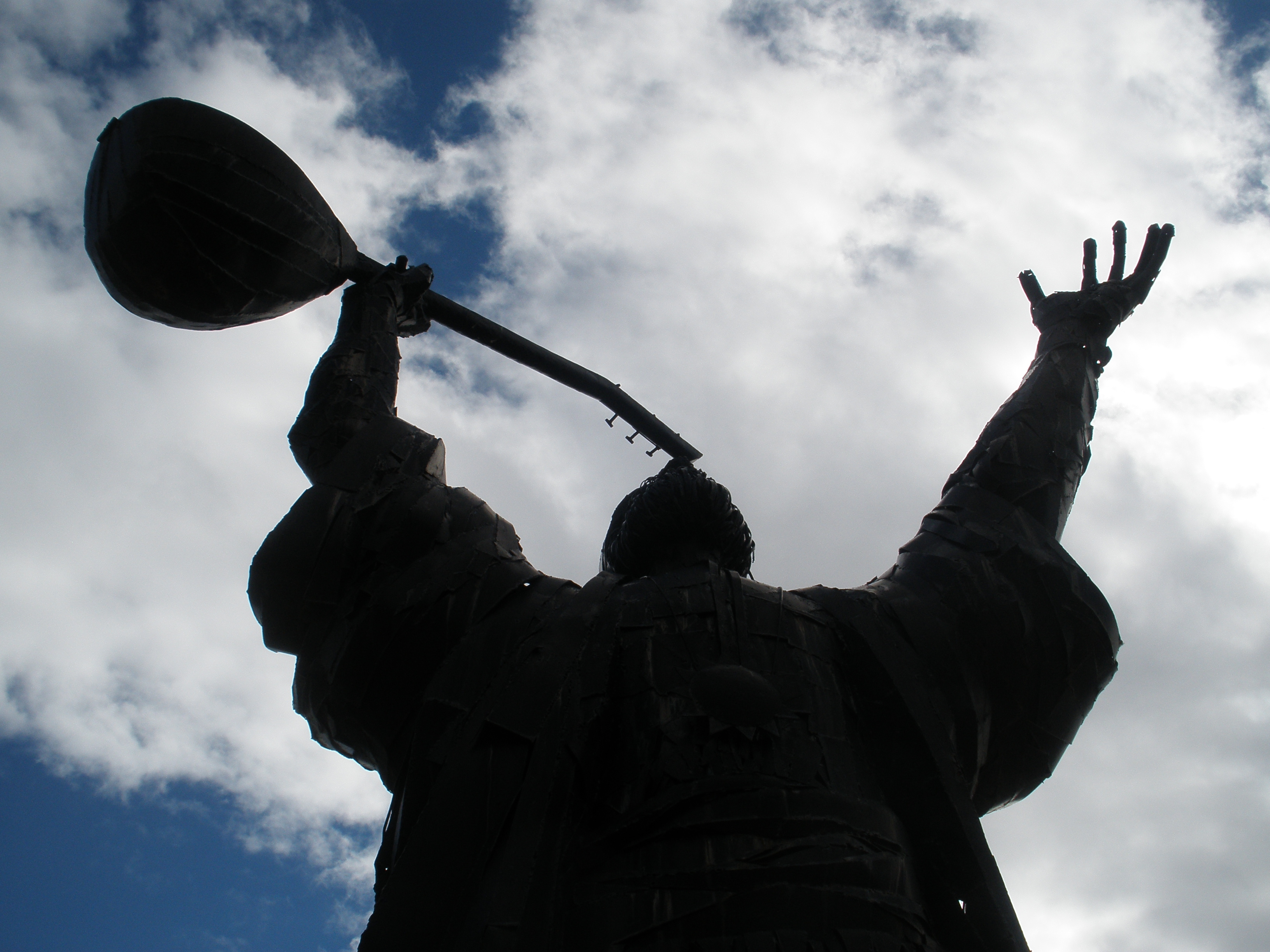
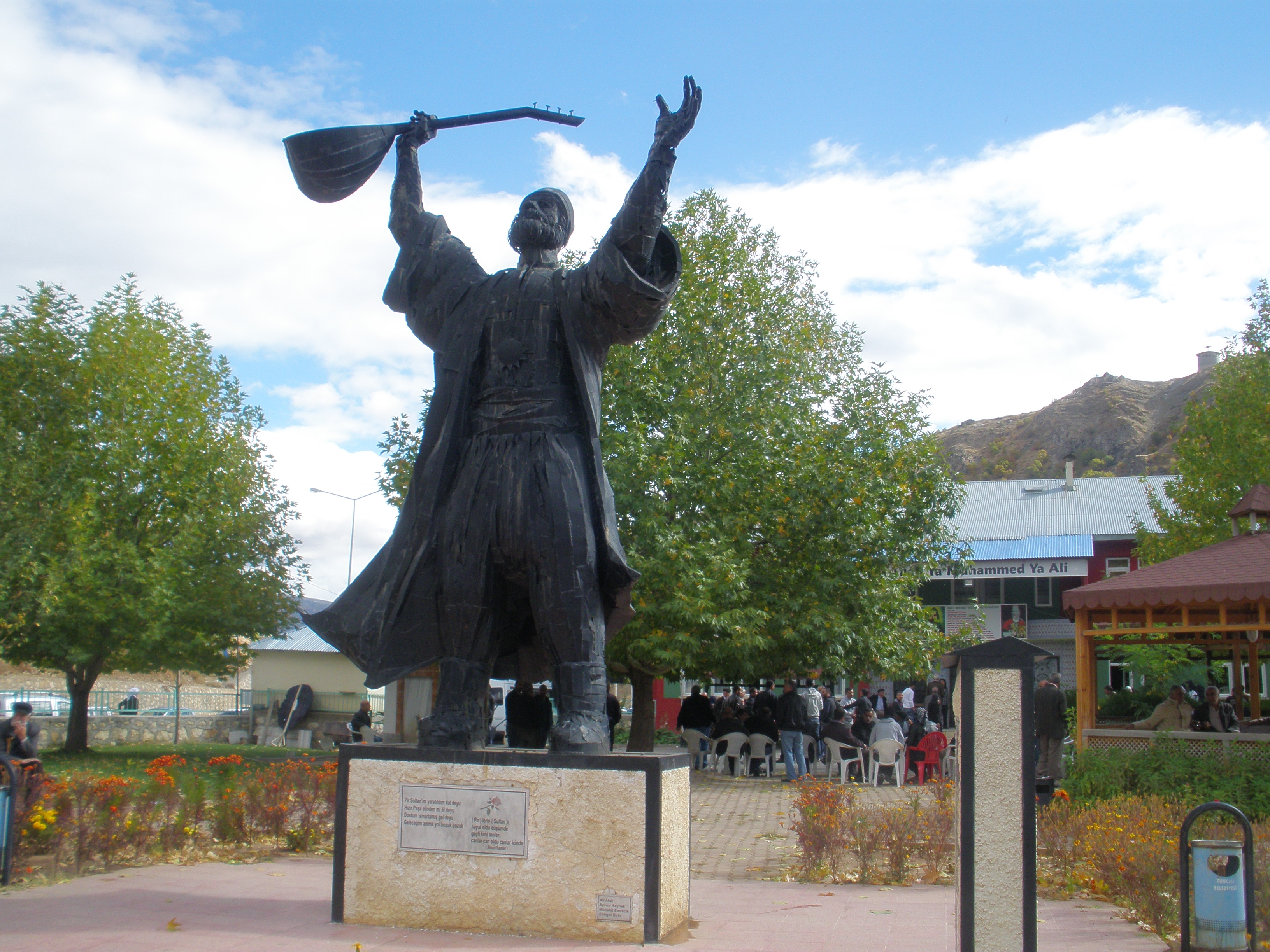
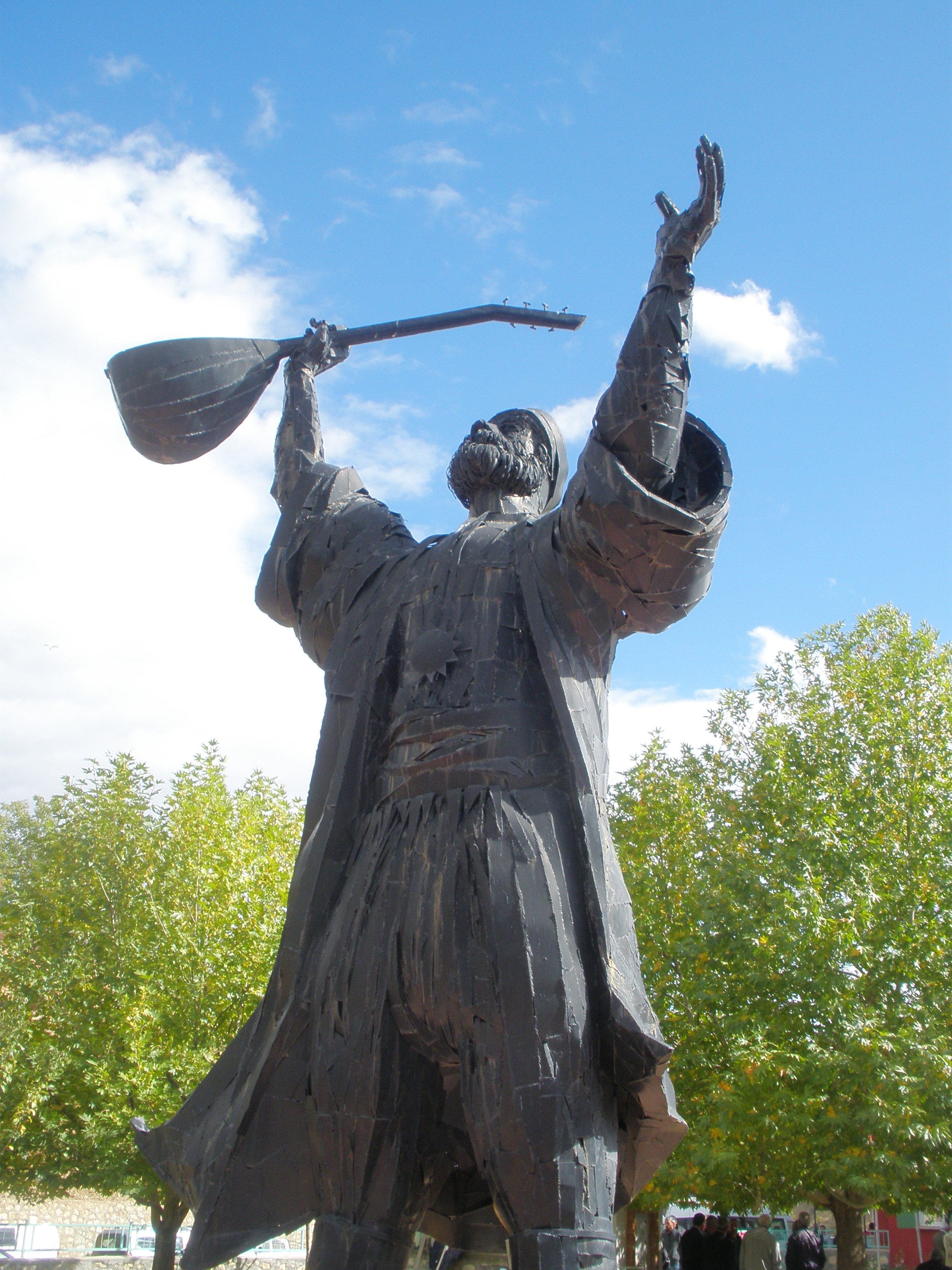
The most famous statue erected in honour of Pir Sultan Abdal or course remains the eight metre tall statue on the hill above the village of Banaz, where it stands gazinPir Sultan Abdal statue at Tuncelig towards the distant but imposing peak of Yıldız Dağı (Star Mountain). Photographs of that statue, taken during the annual Pir Sultan Abdal festival appear in a number of places on this blog, for example here. The aşık statue on Çilehane hill above the town of Hacıbektaş while perhaps not specifically a representation of Pir Sultan, has the standing figure that may certainly be understood to embody something of his spirit. If Banaz (and it’s statue) stand at one end of the heartland associated with Pir Sultan, Tunceli (and it’s statue) perhaps provides the bookend for the eastern regions of this heartland. The Dersim is the great land of Alevi (specifically Kurdish Alevi kızılbaş) resistance and so it is fitting that a worthy icon to Pir Sultan stand here. The statue was erected a decade ago and stands in the grounds of the very fine Tunceli Cem Evi that sits on a cliff above the junction of the Pülümür Çayı (stream) and Munzur Irmağı (river) one kilometre outside the town centre on the Erzincan road. I visited Tunceli and the cem evi in the autumn of 2013. Below is my translation of the dedication monument that sits alongside the statue.

This work, constructed by Sinan Samat, has been presented to the people of Tunceli.

To set up the statue of Pir Sutlan Abdal, the patron saint of ozans, for Tunceli means to remember Imam Hüseyin, Hacı Bektaş Veli and Düzgün Baba.

It also means, again, to commemorate the Pir ozan; and Yunus Emre, Şah Hatayi, Seyit Nesimi, Fuzuli, Virani, Yemini, Kul Himmet, Abdal Musa, Kaygusuz Abdal, Şeyh Bedrettin, Aşık Veysel, Nazım Hikmet, Ahmet Arif, Aşık Daimi, Feyzullah Çınar, Davut Sulari, Muhlis Akarsu, Hasret Gültekin, Nesimi Çimen, Mahzuni Şerif, the teacher Arif Sağ and the souls lost at Sivas and all the ozans and poets wishing to make the world in which we live beautiful.

The lands of Anatolia have given rise to thousands of ozans and poets over the centuries. Our ozans who hold a special place in our folk literature carry on to our own times, in an artistic sense, the beautiful and the bitter events of our culture and the history lived in our lands. They ensure we do not forget our past. Our Tunceli has given rise to ozans who have a special place in the art of the people. Realising this journey I felt it necessary to set up this monument in memory of our ozans.

As a result of the discussions I had with my friends, we agreed on the figure of Pir Sultan Abdal as the patron saint of ozans. Endless thanks first of all to Hasan Güyüldar, Haydar Aygören, Turgut Öker and Yusuf Demir; to my friends who contributed ideas for the realisation of this project; to my sculptor friends; to all who laboured; and to my wife Filiz.

Sinan Samat Tunceli 1-8-2003

The names of the ozans mentioned are interesting and instructive. There is of course the seven great Alevi ozans, Pir Sultan, Hatayi, Fuzuli, Yemini, Nesimi, Kul Himmet and Virani. Then there are those that extend the perception of Alevi culture such as the original great Turkish mystic poet Yunus Emre, the dervish Kaygusuz Abdal and the rebel Bedrettin (who commands a strong influence among Balkan Bektaşi-s). There are the great modern, humanist aşık-s Veysel and Daimi, the latter like Davut Sulari closely associated with the Erzincan region. There is Turkey’s greatest modern literary poet (and Communist) Nazim Hikmet and the Kurdish poet Ahmet Arif famous for his poem Hastretinden prangalar eskittim (set to music and recorded by the late great Ahmet Kaya). There is, slightly curiously (though welcome) inclusion of the influential bağlama player, singer and interpreter of Alevi song (and Turkish folk music more generally) Arif Sağ, noted with the honorific hoca ‘teacher’. So too Feyzullah Çınar and Mahsuni Şerif and Nesimi Çimen who all have born the epithet of a modern day Pir Sultan. And of course, those who perished in the Madımak hotel massacre in Sivas in July 1993: Hasret Gültekin, Muhlis Akarsu and Nesimi Çimen. It is a list of greats well suited to reminding us of the richness of the culture in all its beauty and its pain, as the sculptor intends.

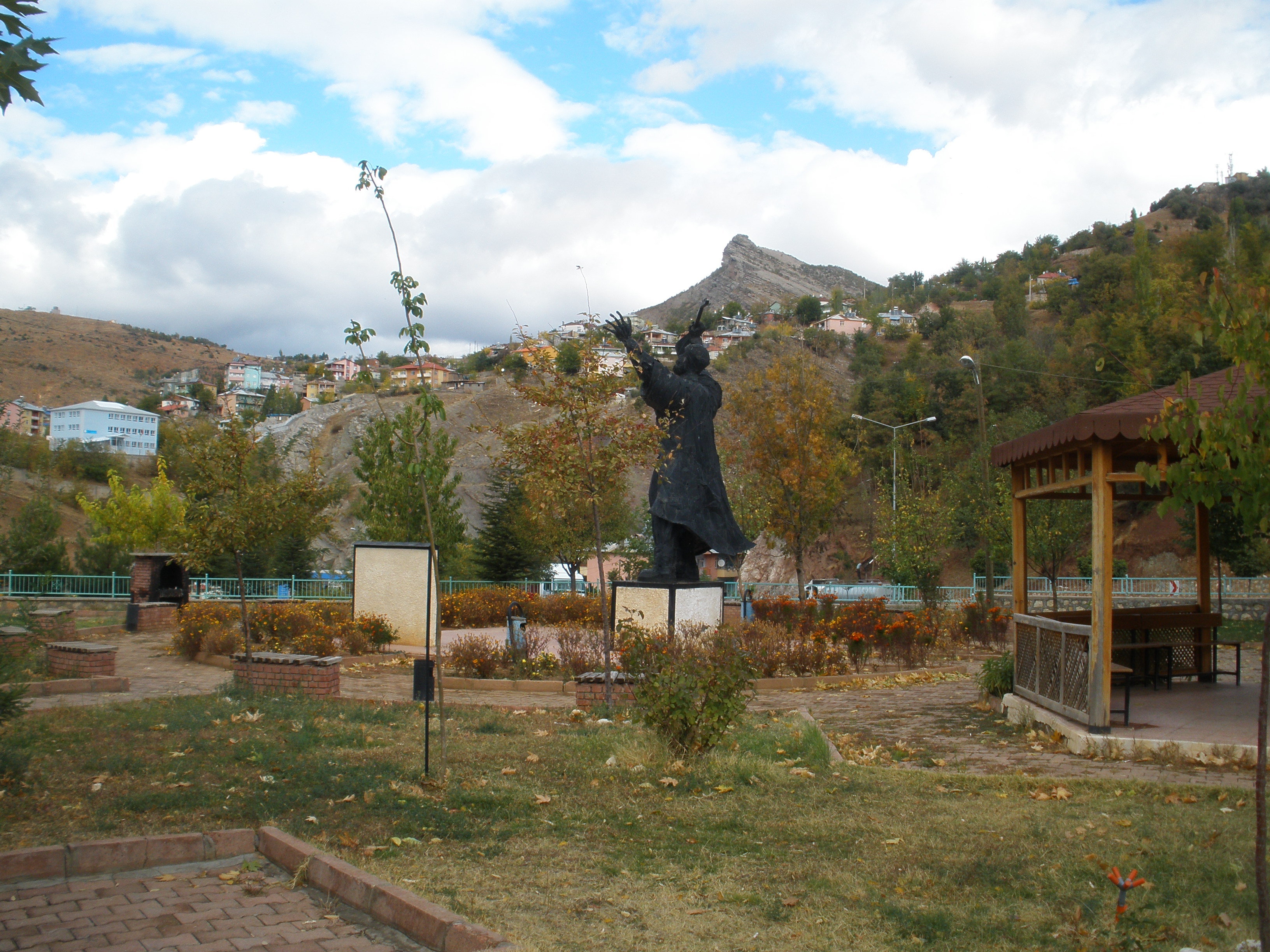
The statue stands in the front garden of the Cem Evi surrounded by 12 seats and a hearth. The following photographs show the context.

Image

In the photograph above note the top right hand corner of the photograph where you can see the watchtower of the ever watchful eye of the Turkish military in this area.

The following photograph is the view looking back towards the Tunceli township.

Pir Sultan Abdal statue at Tunceli looking towards town

OLYMPUS DIGITAL CAMERA OLYMPUS DIGITAL CAMERA

Pir Sultan Abdal ‘Gel güzelim kaçma bizden’

19 Friday Apr 2013

Posted by koerbin in Translations

≈ Leave a comment

Tags

mahlas, Memet Fuat, Shifty lyric voice, Talat Halman, Translation, Yunus Emre

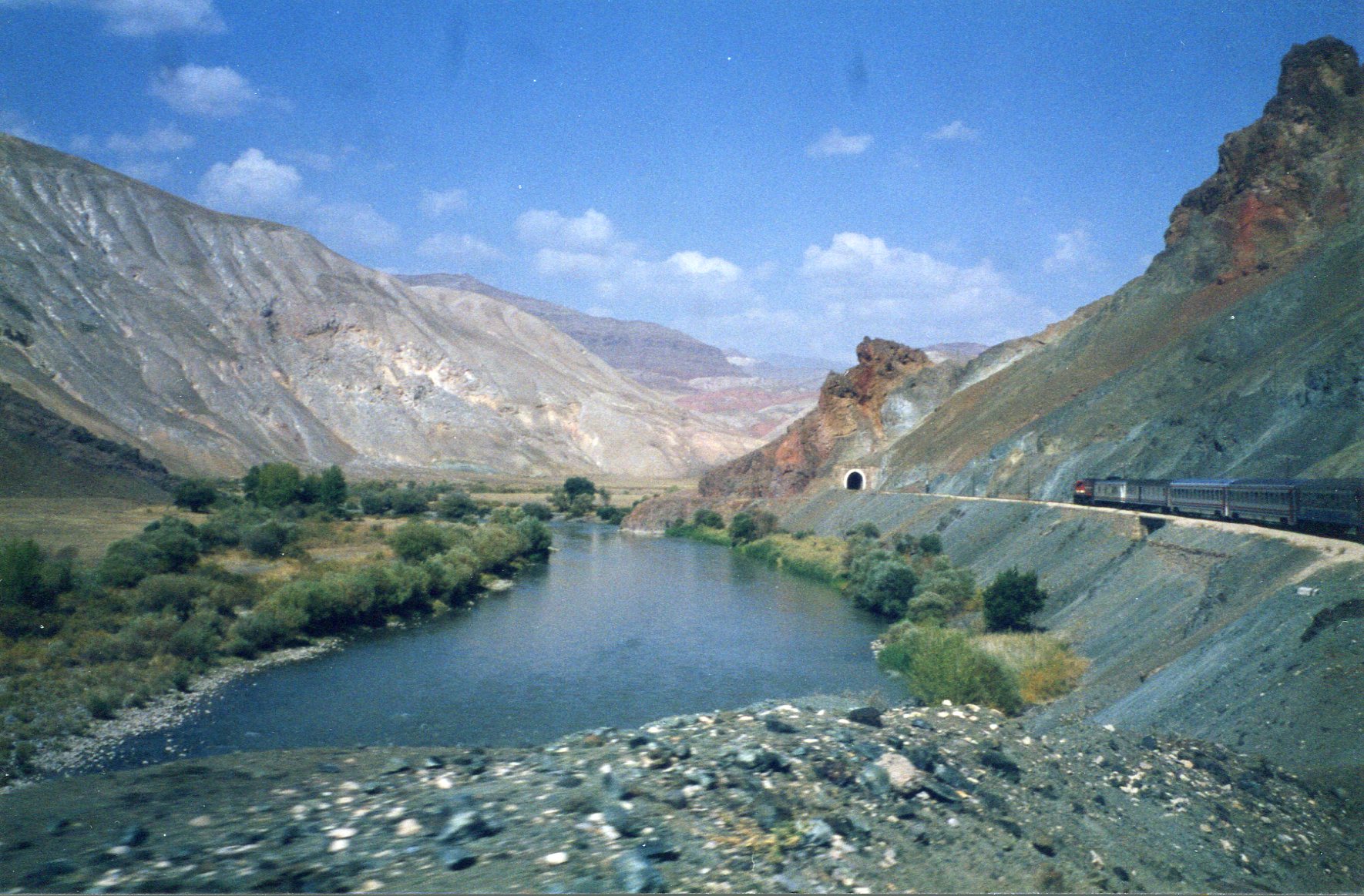
Doğu Ekspres near Divriği mid-1990sHere is a relatively simple but very beautiful lyric that makes an appearance in the earliest Pir Sultan anthologies of Ergun (1929) and Gölpınarlı and Boratav (1943). This is possibly an old lyric and related to the verses of Yunus Emre (see Izzet Zeki Eyuboğlu)- not unknown in the Pir Sultan canon. Later collections show little variation, not surprisingly with a short and perfect gem like this, though Fuad (1977 and 1999) has some slight variations, one of which I follow.

The two Fuad variations are in the first and last lines of the lyric. In the last line Fuad has kor olmuş (a glowing coal) rather than üfrülmüş, meaning to be blown upon, as for example a hot cinder. Fuad’s version seems to be a clarifying or simplifying variant and for reasons of assonance I have gone with üfrülmüş incorporating both variations into my rendering of the line. In the first line the earlier anthologist have benden rather bizden. Given the ‘shifty’ – to use Losensky’s term –  nature of the lyric identity common in these lyrics this is not substantive change. I have used Fuad’s plural version as it aligns with the assonance of the lyric generally. Indeed this is one of the beauties of this lyric for, in the Turkish, the assonance and rhyme express the trance like mystical quality of the lyric. For this reason I have tried, rather more than I usually do, to retain something of this in the English. This does not always, or even often, work since rhyme, alliteration, assonance is much easier and more natural in Turkish with its vowel harmonisation.  Talat Halman is the best at such renderings. I don’t try and replicate the Turkish, but where I have been able to bring in rhyme, near-rhyme and alliteration without diverging from the content of the lyric, I have done so.

Other translation issues to note include the rendering of ehli hal. In the context of the mystical path, ‘hal‘ has the meaning of a transcendent state, a mystical ecstacy even. Hence my version. Erkan means the main points, principles or fundamentals of religion. I did not want to refer to ‘fundamentalism’, perhaps for obvious reasons, so ‘liturgy’ seemed to fit the bill well with its additional help in the rhyme.  Dilden dile means the same as dile düşmek: that is, to become the subject of common talk. I’m not sure I’ve rendered this entirely successfully, though I do get something of the sense and the alliteration was too felicitous to let go. Finally, elden ele causes some problems. It can literally mean ‘hand in hand’ though in this context ‘el‘ would seem to refer to land rather than hand. Fuad certainly indicates this meaning. I did contemplate a line reading ‘we will travel the land hand in hand’ having a bet each way, but perhaps wisely though better of it. My rendering as ‘we will travel the lands far and wide’ is perhaps not too removed from the literal and helps a little with the near-rhyme.

To return to the ‘shifty’ nature of the lyric persona common in Alevi lyric song, this is a great example of this device. The first two verses stress the first person plural (biz, –iz, –elim) then there is the sudden shift in the first line, the mahlas line, of the last verse to the first person singular (I am … ‘-im)) and then the second person (you, –sın) before finally returning to the first person plural. The functions of such shiftiness engaging the lyric voice of the poet with the performer and the audience, I have discussed in my PhD thesis.

Translation: Paul Koerbin

Come, do not desert us, my beauty

We are the nightingale, no stranger we

We are brothers in dervish ecstasy

We are the way within the liturgy


Let us converse on the states of joy

Let us talk ‘til tongues are tired

We will travel lands far and wide

We are the rose freshly opened


I am Pir Sultan, for what do you cry?

You shed tears of blood from your eye

What you expect from us, is it fire?

We are ashes of embers blown and burned

Gel güzelim kaçma bizden

Yad değiliz bülbülüz biz

Biz hâl ehli kardaşlarız

Erkân içinde yoluz biz


Söyleşelim hâlden hâle

Dilleşelim dilden dile

Biz gezeriz elden ele

Taze açılmış gülüz biz


Pir Sultan’ım ne ağlarsın

Gözünden kan yaş çağlarsın

Sen bizden ateş m’umarsın

Yanmış üfrülmüş külüz biz

Aşık Mücrimi ‘Şu diyâr-ı gurbet elde’ (Şen değil gönlüm şen değil)

25 Wednesday Apr 2012

Posted by koerbin in Translations

≈ 4 Comments

Tags

Arif Sağ, Aşık Mücrimi, Aşık Meluli, Aşık İbreti, Cafer Ağa, mahlas, Müslüm Gürses, Nesimi Çimen, Ulaş Özdemir

The performer and musicologist Ulaş Özdemir in his published collection of Mücrimi’s lyrics considers him alongside Aşık Melûli and Aşık İbreti as the great representative aşık-s of their time. This is Mücrimi’s most famous song, associated particularly with Aşık Nesimi Çimen and undoubtedly helped to the status of a classıc by superb recordings of the song by Arif Sağ on his 1983 recording İnsan Olmaya Geldim and later by Müslim Gürses on his 2001 recording Müslüm’ce Türküler. Sağ’s version is restrained, tempered with space that lets the song unfold profoundly – as is typical of that remarkable album. Gürses’s singing has a more searing quality and is beautifully delivered, like Sağ, just to bağlama accompaniment.

Mücrimi whose real name was Mehmet Özbozok was born in 1882 in Karaterzi village in the Doğanşehir locale of the Malatya region. Özdemir tells us that according to the explanation of Mücrimi’s children he was given the mahlas ‘Mücrimi’ by a descendent of İmam Mûsâ’l-Kâzım. As a child he burned his hand resulting in his fingers being bandaged in the shape of a ball and he was given the nickname ‘çolak‘ meaning crippled or one-armed. And this nickname was apparently the inspiration for the mahlas Mücrimi which has connotations of being guilty or a criminal. Mahlas taking is a fascinating subject and here we can see elements of bestowing authority of lineage, reference to the specifics of one’s life or appearance and ironic humour.

Aşık Nesimi Çimen spent some time with Mücrimi but, again according to what Özdemir reports, the song came to Çimen through his father-in-law Cafer Ağa of Sarız (Elbistan) who Mücrimi had great regard for. It was through Nesimi Çimen’s singing the song in various gatherings that it entered the repertoire of other artists; and later became part of the official TRT repertoire. In my PhD thesis I discussed another song Arif Sağ collected from the singing of Nesimi Çimen (and included on İnsan Olmaya Geldim) called ‘Yarim İçin Söylüyorum’, a song in türkü form although it has the suggestion of a mahlas in the line ‘Cafer der sevdalı kuldu’. At the time of writing my thesis I stated that I could not identify the poet ‘Cafer’, but now I would conclude that it appears highly probable that this Cafer is none other than Cafer Ağa.

The commonly performed versions omit the third verse (the ‘oh Lord’ verse) and alter the penultimate line of the last verse. That line certainly presents the biggest translation challenge. In the recorded versions this line is changed to ‘zalımlardan [or cahillerden] yedi taşı‘ and I have been guided by this variant in my translation. Even still it requires some interpretation since it would seem to be a reference to the Muslim  ‘stoning of devil’ ritual personalised and inverted in a typically deft Alevi way. I translate ‘intizar’ as an ‘expectation’ or ‘waiting’ although it may also mean a ‘curse’ though I don’t think so in this context – though it is a shade of meaning unfortunately lost in translation.

Aşık Mücrimi: Şu diyâr-ı gurbet elde

Translation: Paul Koerbin

In exile in this strange land

No joy, my heart knows no joy

No one knows of my condition

No joy, my heart knows no joy

I caused my heart injury and pain

My heart descended into despair

Whether fortune or fate, it is black

No joy, my heart knows no joy

I have wept, make me laugh, oh Lord

I am broken down, raise me up, oh Lord

My condition is clear to you, oh Lord

No joy, my heart knows no joy

I went around dizzy and distracted

I can read and I can write

Day and night I am in anticipation

No joy, my heart knows no joy

Mücrimi says, my eye, my tear

My mind is not free from grief

Stones rain upon me from tyrants

No joy, my heart knows no joy

—————————————————————————

Text from Ulaş Özdemir Şu diyârı- gurbet elde: Âşık Mücrimî’nin yaşamı ve şiirleri (Pan, 2007)

Şu diyâr-ı gurbet elde

Şen değil gönlüm şen değil

Kimse bilmez ahvâlimden

Şen değil gönlüm şen değil

Ben sinemi yaktım nâra

Gönül düşmüştür efkâra

Teccellî mi baht mı kara

Şen değil gönlüm şen değil

Ağlamışım güldür yâ Rabb

Düşkününüm kaldır yâ Rabb

Hâlim sana ayan yâ Rabb

Şen değil gönlüm şen değil

Ser-gerdân olmuş gezerim

Hem okuyup hem yazarım

Gece gündüz intizârım

Şen değil gönlüm şen değil

Mücrimî der dîdem yaşım

Gamdan ayrılmıyor başım

Adûlardan değer taşım

Şen değil gönlüm şen değil

Pir Sultan Abdal ‘Hû diyelim Gerçeklerin demine’

18 Wednesday Jan 2012

Posted by koerbin in Translations

≈ 2 Comments

Tags

Derviş Ruhullah, Hallaj al-Manusr, har, John Kingsley Birge, mahlas, Sadık Hüseyin Dede, Translation, Ulaş Özdemir

The text used for the translation here comes from Gölpınarlı and Boratav’s 1943 work on Pir Sultan Abdal with the original sources given as the early 20th century publication of Derviş Ruhullah and cönk in Gölpınarlı’s possession. Interestingly it does not appear in Ergun’s 1929 collection of Pir Sultan Abdal lyrics. A version, with remarkably little textual variation was recorded by Ulaş Özdemir for his 1998 album of Maraş Sinemilli deyişler called Ummanda. The version of this song was collected from Sadık Hüseyin Dede. The principal variation being in the opening lines, “Arzusun çektiğim gül yüzlü dostum / Erenlerin demi hurdan sayılır”, and in the form of the mahlas being Abdal Pir Sultan’ım, a form that seems rather typical of Pir Sultan deyiş collected from this region.

It is one of the category of Pir Sultan lyrics extolling sincere commitment to the dervish way. While conscious of the subtlety that will be lost, I have translated as ‘dervish’ – a term in English that has a wide embrace – a number of different terms that appear in the lyric, including gerçekler (the true ones), er (man, as in one who is brave or capable), aşık (devotee) and eren (one who has arrived at divine truth). Perhaps the most difficult line in the translation, not helped by its crowning a particularly paratactic verse,  is “Biri kırktır kırkı birden sayılır” and I am not entirely comfortable with my rendering in terms of accuracy or eloquence – a work in progress. I make less apology for the rendering of the final line and the introduction of the word ‘prick’ with some of (if not all!) its English connotations (certainly in Australian idiom as someone who is a bit of a ‘waste of space’). The play on words is justified by the connection to the preceding diken (thorn) and the multiple connotations of har/hâr meaning thorn, something that pricks, to go wild, a donkey or foolish person, vile or contemptible. I have seen a version of the lyric with hal instead of har, though that versions seems to diminish the robustness of the lyric’s climax. This is a fine and robust lyric and this rendering seems apposite to my ear.

Finally a word on a couple of references that might be slightly confusing. Firstly, in the final verse (another with evident parataxis) Baghdad is referred to as the motherland (vatan) which may seem at odds with Pir Sultan’s Anatolian presence. In fact this is clearly a metaphorical reference, or perhaps more correctly metonymical. Baghdad, here referred to as a motherland, would seem to be a metonym for Pir Sultan’s identification the mystical tradition founded in Baghdad and particularly associated with Hallaj al-Mansur, who in the tradition is believe to have been martyred for his expression that he was the ‘truth’ (enel hak). Secondly, the reference to ‘Muhammed Ali’, which I follow without the insertion of a conjunction in my English rendering. To paraphrase John Kingsley Birge – whose remarkable 1937 work, while specifically based on western Anatolian and Albanian Bektashi tradition, rather than Alevi tradition, remains an essential text and of great value on such matters – this does not refer to a single personage of that name but as if two names of the once concept, which is the concept of Muhammad and Ali as complementary personifications representing the divine radiance (nur). Indeed the expression of trinity is also common in Alevi tradition, as in: Allah Muhammed Ali.

Pir Sultan Abdal: Hû diyelim Gerçeklerin demine

Translation: Paul Koerbin

Let us say ‘hu’ to the breath of the true dervishes

The breath of the true dervishes is deemed from the light

One who is brought in train to the Twelve Imams

Is counted among the beloved for Muhammad Ali

Who comes with sincere belief  does not turn from this way

A friend does not know duplicity in his friend

Who does not see the dervish is truth does not see truth

His eyes watch but he is counted among the blind

The pleasure of the world was but three days, so they say

Following pleasure there  is suffering, supposed

Of the speech and the sigh of the true dervishes

One of them is Forty – counted one among the Forty

If the true dervish stops at the halting place

If, burning like a candle, his sap dissolves

If he perceives, what remains is the true self

He is a dervish counted among the true dervishes

I am Pir Sultan Abdal – Baghdad the motherland

Passing from duplicity to unity

The one who joins the way of the dervishes sniping

Is the thorn in the way and counted among the pricks

——————————————————————————

Turkish text from Gölpınarlı and Boratav Pir Sultan Abdal (1943)

Hû diyelim Gerçeklerin demine

Gerçeklerin demi nurdan sayılır

On İk’İmam katarına düzelen

Muhammed Ali’ye yârdan sayılır

İhlâs ile gelen bu yoldan dönmez

Dost olan dostunda ikilik bilmez

Eri hak görmiyen Hakkı da görmez

Gözü bakar amma körden sayılır

Üç gün imiş şu dünyanın safası

Safasından artuk imiş cefası

Gerçek Erenlerin nutk u nefesi

Biri kırktır kırkı birden sayılır

Gerçek âşık menzilinde durursa

Çırağ gibi yanıp yağı erirse

Eksikliğin kend’özünde görürse

O da erdir gerçek erden sayılır

Pir Sultan Abdal’ım Bâğdattır vatan

İkilikten geçip birliğe yeten

Erenler yoluna kıyl ü kal katan

Yolun dikendir hârdan sayılır

18th Pir Sultan Abdal Etkinlikleri (Festival) 2007

15 Wednesday Jun 2011

Posted by koerbin in Banaz

≈ Leave a comment

Tags

Aşık Garip Kamil, Aşık İsmail Şimşek, Banaz, Dertli Divani, Erdal Erzincan, Mercan Erzincan, Pınar Sağ, Tolga Sağ, Yıldız Dağı

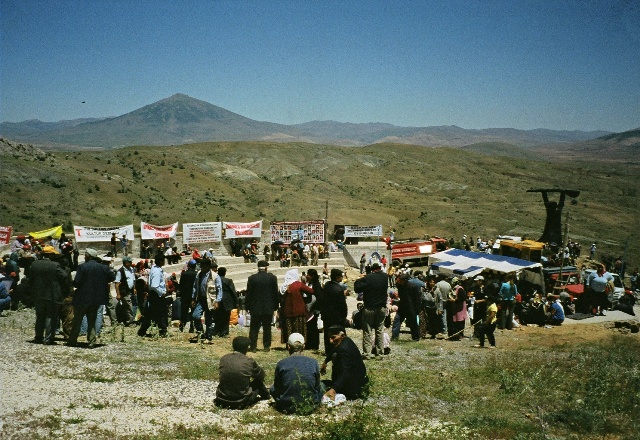
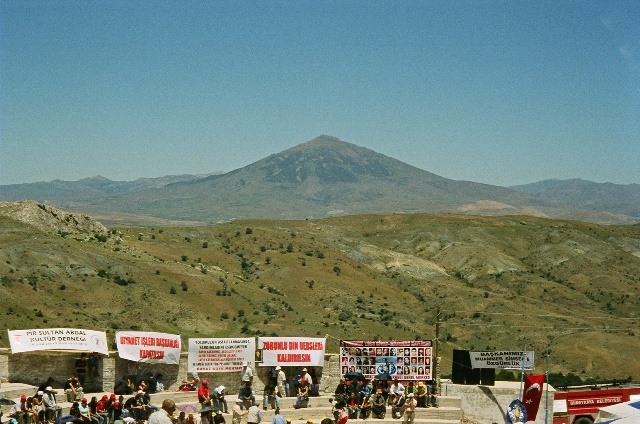
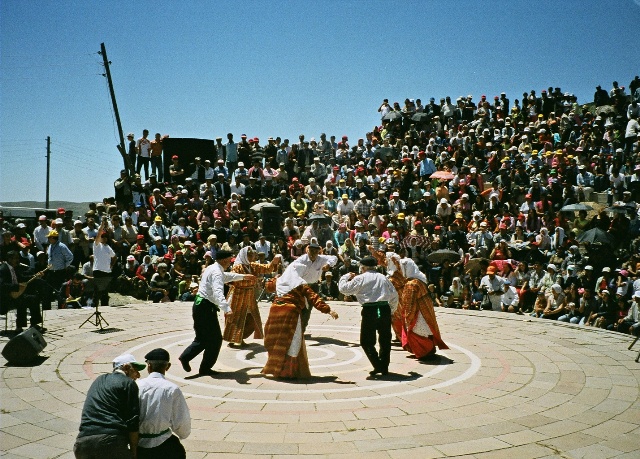
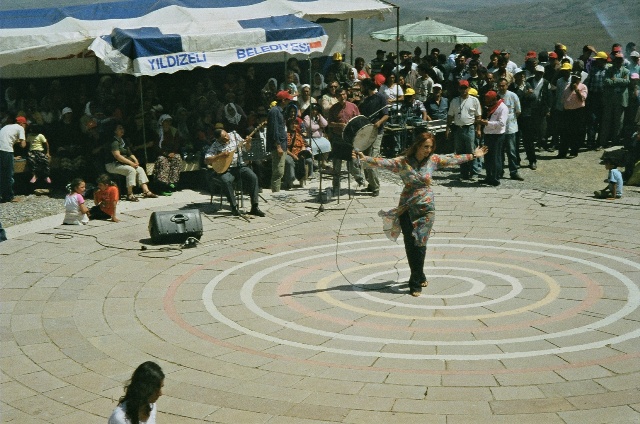
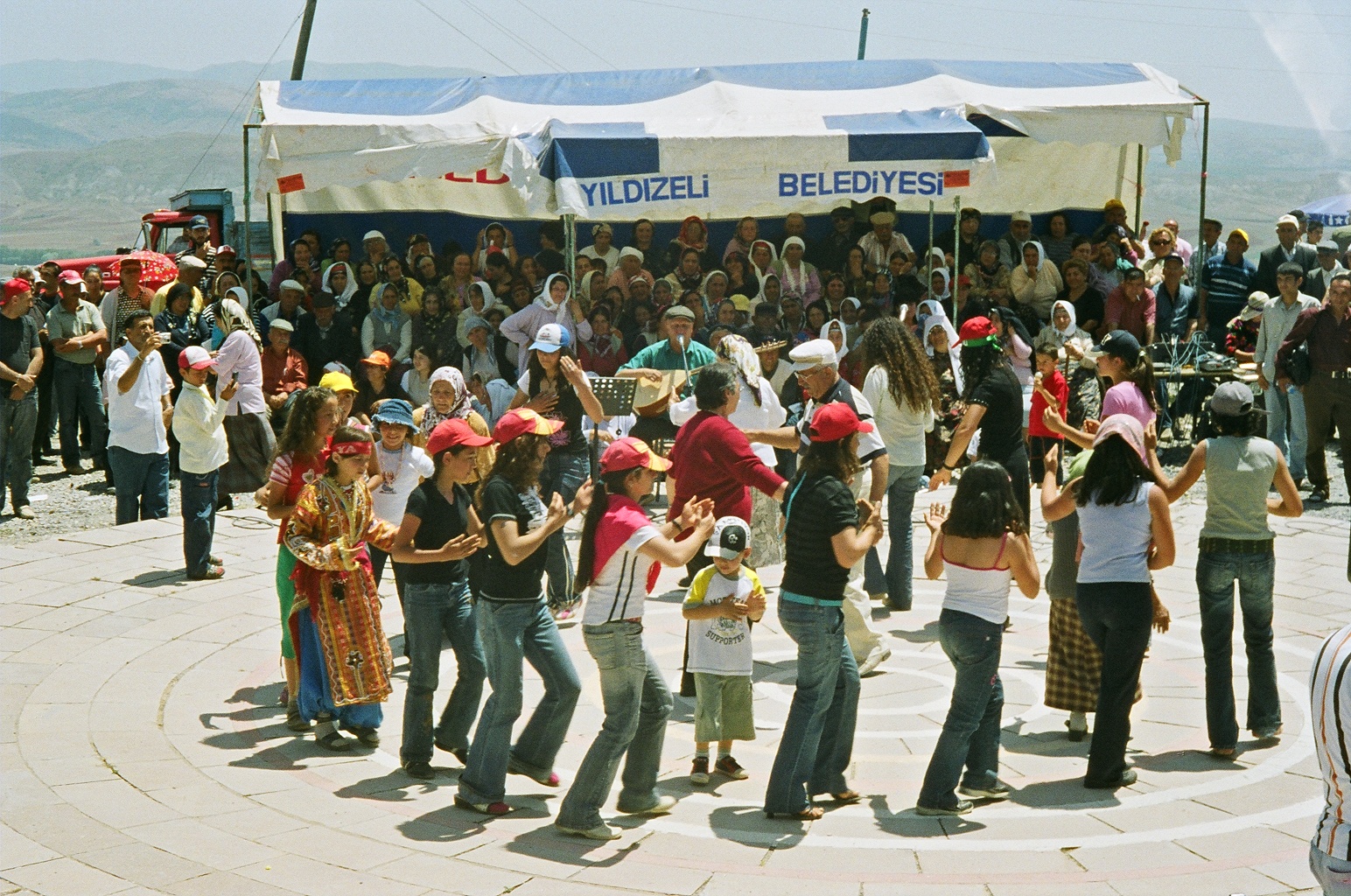
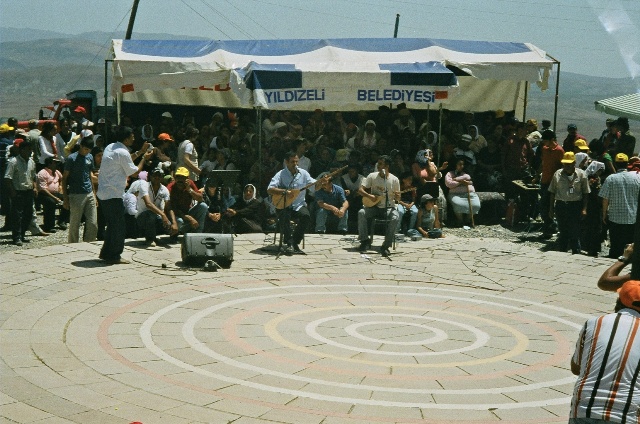
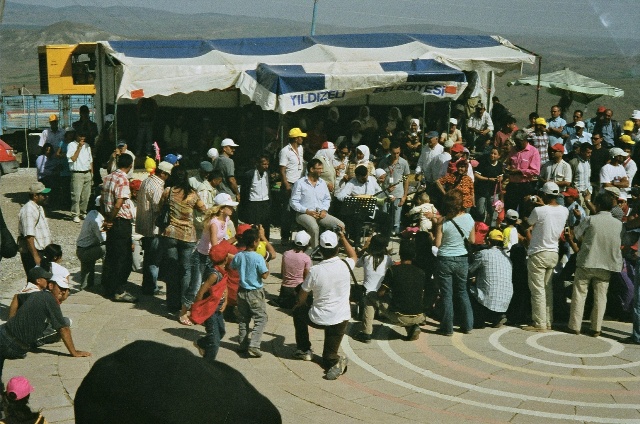
Some photos from the last Pir Sultan Abdal Şenlikleri (Festival) that I attended in June 2007. The location is the village of Banaz, north of Sivas.

General view of the performance amphitheatre on Ziyaret Tepe above the village.

View of Yıldız Dağı from the amphitheatre, with banners.

Banazlı aşık İsmail Şimsek opening the performances with Banazlı turning the semah.

Mercan Erzincan performing with group.

Pınar Sağ with backing group.

Aşık Garip Kamil and semah turning.

Dertli Divani

Tolga Sağ and Erdal Erzincan late on Sunday afternoon.

Lokma kurban preparation on Topuzlu Baba

Muhlis Akarsu ‘Gurbeti ben mi yarattım’

25 Friday Mar 2011

Posted by koerbin in Translations

≈ 5 Comments

Tags

Arif Sağ, gurbet, koşma, mahlas, Muhabbet, Muhlis Akarsu, Musa Eroğlu, semai

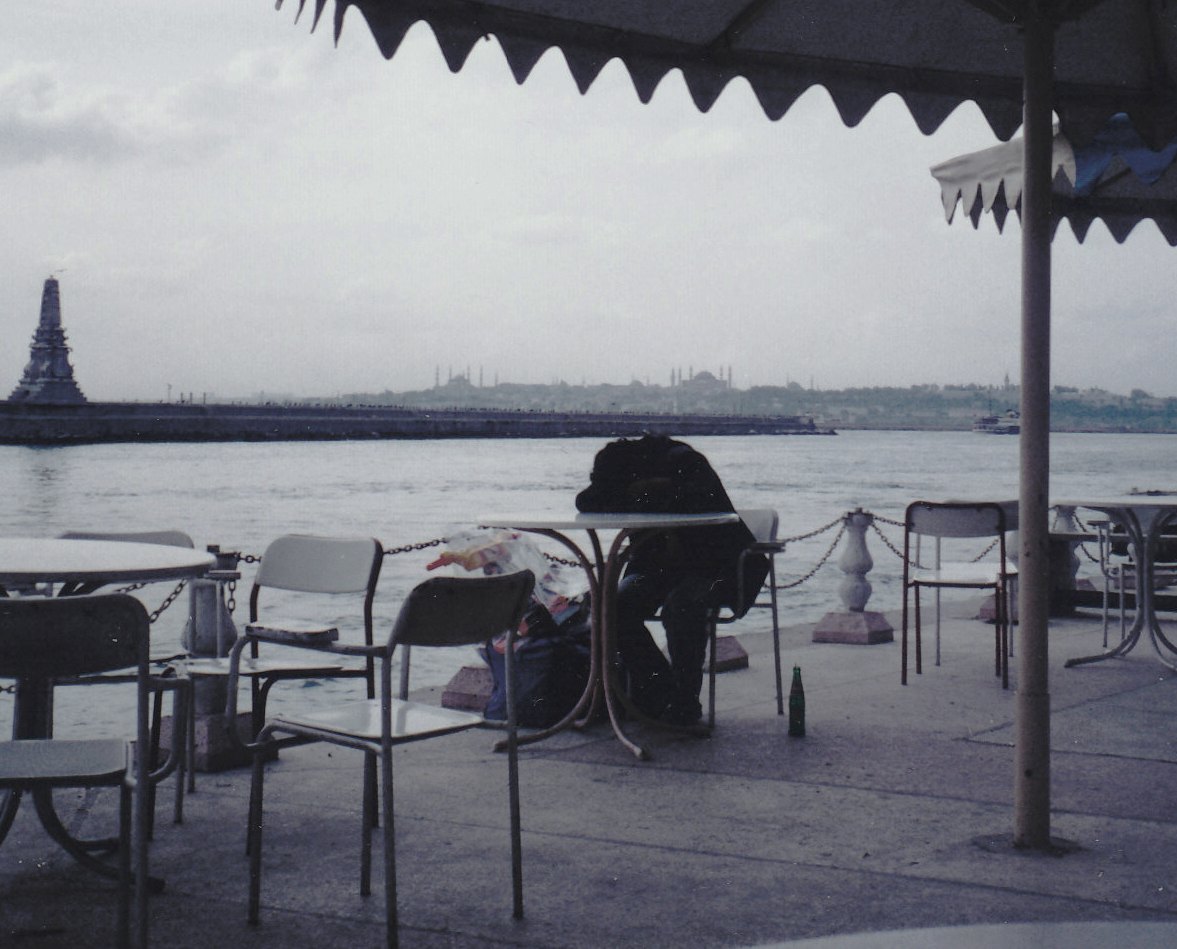
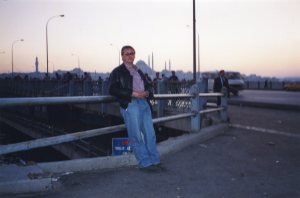
Galata bridge at sunset 1999

Galata Bridge, Istanbul, 1999

When Arif Sağ re-emerged as a recording artist in the early 1980s having given away his arabesk career in the mid-1970s and worked as a teacher at the İstanbul Devlet Türk Müziği Konservatuarı, he released a cassette album called Gurbeti ben mi yarattım. The title song was from the Kangal aşık Muhlis Akarsu. Sağ’s recording is intimate and almost reticent – very striking in a restrained way. Oddly the cover of the cassette that I obtained in Urfa in 1987 (which I believe is the original 1981 release) has a photograph of Sağ (see photo below) that harks back to his arabesk days, dressed in yellow zip up blazer, slicked down hair and pencil moustache – totally belying the intimate sound of voice and bağlama on the recording. This would be the recording that began Sağ’s stylistic hegemony over the performance of Alevi music in the 1980s and 1990s. The iconography was yet to catch up.

sag_gurbeti_ben

Sağ recorded the deyiş again for the second of the Muhabbet series of recordings two or three years later. Muhabbet 2 is arguably the finest of the series in terms of its thematic strength which centres around the concept of gurbet – absence from one’s native place or home. Gurbeti ben mi yarattım is the final song on that recording although only three of the four verses are sung (the second is ommited) with Sağ, Musa Eroğlu and Muhlis Akarsu taking turns on the verses – a quite unusual approach for the Muhabbet series. Akarsu of course recorded the song but sadly, although a number of his recordings have been issued on CD, that one has not. However a recording of Akarsu performing it live is available on YouTube.

Gurbet is obviously the theme of the deyiş and this is deepened to almost ‘starkly bleak’ – thanks Tom Rapp! – realms with the addition of the theme of yokluk – which refers to absence, even to the degree of non-existance (it also has a meaning of poverty). I don’t think I’ve captured the full sense of yokluk so that will require working on. Another word to mention is sıla in the mahlas line which I have rendered as ‘returning’ but it really means return to family, friends and one’s native place – the opposite really of gurbet. A good translation here for imkân also rather eludes me. Having tried ‘possibilities’ it sounded too lumpen and ‘practicalities’ would be even worse. For the moment ‘chances’ it is. The deyiş is in the short koşma form (semai) with only 8 syllables per line which gives it a simple directness; but it is constructed with typical economy and finesse.

Muhlis Akarsu: Gurbeti ben mi yarattım

Translation: Paul Koerbin


Destitution has compelled me

Was it I who created the exile?

It came and took my youth

Was it I who created the exile?

I received neither letter nor news

Parted from my country and home

I felt the loss of all that was mine

Was it I who created the exile?

Evening comes and the shadow settles

Winds blow against my hope

Absence constrains my chances

Was it I who created the exile?

Akarsu, don’t think about returning

Don’t believe this isolation has passed

How I fell upon helplessness

Was it I who created the exile?

————————————————————————————

Turkish text from Muhlis Akarsu: yaşamı, sanatı, şiirleri ve dünya görüşü by Süleyman Zaman, 2006.

Yokluk beni mecbur etti

Gurbeti ben mi yarattım

Gençliğimi aldı gitti

Gurbeti ben mi yarattım

Ne mektup ne haber aldım

Yurdumdan yuvamdan oldum

Her şeyime hasret kaldım

Gurbeti ben mi yarattım

Akşam olur gölge basar

Umuduma yeller eser

Yokluk imkânımı keser

Gurbeti ben mi yarattım

Akarsu sılayı anma

Bu ayrılık geçti sanma

Çaresizdim geldim amma

Gurbeti ben mi yarattım

← Older posts

Blog at WordPress.com.

  • Subscribe Subscribed
    • PİR SULTAN ABDAL and me
    • Already have a WordPress.com account? Log in now.
    • PİR SULTAN ABDAL and me
    • Subscribe Subscribed
    • Sign up
    • Log in
    • Report this content
    • View site in Reader
    • Manage subscriptions
    • Collapse this bar
 

Loading Comments...