• About Pir Sultan Abdal
  • About the ‘me’ in this blog
  • Index of translations on this blog
  • More translations available in my PhD thesis
  • Regarding the translations on this blog

PİR SULTAN ABDAL and me

~ A personal reflection on the great Alevi poet's lyric works and influence – mostly through translation

PİR SULTAN ABDAL and me

Tag Archives: Edip Harabi

Two minor works from Edip Harâbî – one on taking the mahlas ‘Harâbî’ and the other a (slightly vulgar) improvised satire

09 Thursday Jan 2025

Posted by koerbin in Translations

≈ Leave a comment

Tags

Edip Harabi, mahlas, Translation

Ahmed Edip Harâbî (1853-1917) was one of the most important Bektashi poets of the late 19th and early 20th centuries. He is known for his great ‘cycle of existence’ – or devriye – poems such as the one presented and translated by John Kingsley Birge in his seminal 1937 publication The Bektashi Order of Dervishes, beginning (in Birge’s translation):

Before the ‘B’ and the ‘E’ ever appeared

We are the beginning of the universe

Before any became joined to the face (of God)

We are the ‘distance of two bows or closer’

Or his great, long poem the ‘Vahdetname’ – a truncated version (about half) of which was included in translation in Jennifer Ferraro and Latif Bolat’s publication of ‘mystical rebel poems of the dervishes of Turkey’ titled Quarreling with God (Cloud Press, 2007). Both of these works survive with musical arrangments. The ‘Vahdetname’, as performed by Emekçi, was included on the groundbreaking album Kızılbaş prepared by Ulaş Özdemir for Kalan Müzik in 2009; as Özdemir has said, this was an album put together with the idea of initiating a series of albums to present the most ‘radical’ Alevi-Bektashi works yet recorded. (Kalan produced a second Kızılbaş named album in 2011 and in 2014-2015 a follow-up series of two double CDs titled Aleviler’e‘.) Moreover, as Özdemir says, this album “is from beginning to end a political work … [from] the viewpoint of Alevi-Bektashi communities in their everyday lives lives as well as in their faith”. It is weighty with works by Harâbî – as well as the Vahdetname there are two other works by him including the opening track given the title ‘Kızılbaş’ – as well as songs from other hard edged Alevi (Kızılbaş) poets such as Teslim Abdal and İbreti.

Harâbî was known to improvise many of his poems but he did leave behind a large manuscript collection amounting to around 519 poems. Interestingly, he included many brief comments about the context of a number of these improvisations. Harabi’s works range from the mystical to the satirical showing the influence of the greats from Yunus Emre to Pir Sultan to the biting satire of Kaygusuz Abdal. Harâbî is also notable for composing works in various identities including female identities using the names Lutfiye and Zehra Bacı (for more on Harabi’s writing as Bektashi ‘sisters’ see the 2017 paper by Ömer Ceylan titled: “Bektâşî diliye kadın müdâfaası” Edip Harâbî’nin Lutfiye ve Zehra bacılar ağzından yazdığı nefes).

The two works I have translated here are certainly minor works, but interesting in themselves. The first is one that attracted my attention when researching for my PhD on the mahlas – self-naming convention – in Alevi lyric song. In this poem Harâbî refers to his taking of the mahlas Harâbî – even giving dates, making the point that taking the mahlas is a transcendent act that connects to a tradition or master (in this case from Mehmed Ali Hilmi Dede Baba, who we met in my previous post being somewhat disparaged by Vahid Dede for his ‘syrupy’ musical influence). Harâbî includes notes about the dates and numbers in this work, saying this was spoken ‘nutku söylediğim‘ in 1318 [1902], he was born in 1269 [1853], he is currently 49 years of age, he was initiated into the dervish order – nasîb aldığım – at the age of 17 and has completed 32 years as an initiate.

The second poem – an improvised ghazel (or not a ghazel as the title suggests) – is something quite different. On my initial reading it reminded me of Catullus in his personally directed satire and vulgar insult. Such works as this certainly bring to life a real person behind some of the most sublime mystical works and indeed he uses his birth name ‘Edip’ as the mahlas in this poem. Harâbî includes a note to this poem to the effect: ‘said for an errant gentleman as needed’. He also provides a rather cryptic introductory note saying it is a published “improvisation … people who don’t know how to fly prevent flying birds from flying, and some people, the honorable ones, have made the wings of the flying birds fly more than the flying bird, for God’s sake! 12 March 1324 [1906]”.

Edip Harâbî : Peder ve vâlidem oldu bahâne

Translation: Paul Koerbin

My father and mother were the root cause

The restlessness of two oceans meeting

In one thousand two hundred and sixty-nine

Manifest I arrived and came into the world

I was freed from this world and I withdrew

At seventeen years of age from my birth

From Mehmed Ali Hilmi Dede Baba

Let there be thanks, I achieved the possibility

My name was Edip and I became Harabi

I was dust at the feet of the Enlightened

I became an opened book for them

Proclaiming ‘let there be love’ to the Knowing

——————————————————-

Original text from: Dursun Gümüşoğlu, Ahmed Edîb Harâbî Dîvânı: yaşamı ve tüm şiirleri (3rd ed. Can Yayınları 2013), p. 182

Peder ve vâlidem oldu bahâne

Merec-el-bahreyni yeltekıyâne

Bin iki yüz altmış dokuzda kâne

Eriştim zâhiren geldim cihâne

Berzahtan kurtuldum çıktım aradan

On yedi yaşında doğdum anadan

Mehmed Ali Hilmi Dede Baba’dan

Çok şükür hamd olsun geldim imkâne

Nâmım Edip idi Harâbî oldum

Erenlerin ayak türâbı oldum

Anınçün herkesin kitâbı oldum

Aşk olsun okuyan ehl-i irfâne


Edip Harâbî : Gazel değil Hazel

Translation: Paul Koerbin

Oh Kamil Efendi, why do you act so foolishly?

You go awry abandoning the right path

If your jacket is torn and button on your pants snaps off,

And you can’t find thread, with what would you stitch it?

If you have a secret place, fine, or if perhaps you don’t,

If you find a jenny, where would you screw it?

You can’t appreciate this poem being a small gem

And now you pervert this true word

You’ll destroy the garden of the perfect one

Is it apt, Edip, so you sow the seed of forgetfulness?

—————————————————————

Original text from: Dursun Gümüşoğlu, Ahmed Edîb Harâbî Dîvânı: yaşamı ve tüm şiirleri (3rd ed. Can Yayınları 2013), p. 483

Ey Kamil Efendi neye çahillik edersin

Doğru yolu terk eyleyerek eğri gidersin

Yırtılsa caket pantolonun düğmesi kopsa

İplik bulamazsın anı sen neyle dikersin

Gizli yeriniz varsa güzel, yok ise şayet

Bir kancık eşek bulsan onu nerde düzersin

Bu şi’ir-i güher paremi takdir edemezsin

Bu doğru sözü şimdi de sen eğriye çekersin

Kamil olanın tarlasını mahv edeceksin

Layık mı Edib böyle nisyan tohumu ekersin
Latife Bacı (Melûli) ‘Mey içtim sarhoşum bugün’

26 Saturday Feb 2011

Posted by koerbin in Translations

≈ 1 Comment

Tags

Aynur Haşhaş, deyiş, Edip Harabi, Latife, mahlas, Melûli, Translation

Otel Fahri İstanbul 1995Aşık Melûli is surely one of the master Alevi poets of the twentieth century. Indeed his life spans nine decades of the century. Born in 1892 his real name was Karaca and was educated both by an Arab hoca and for a decade in an Armenian school in Afşin. As well as his mother tongue Turkish he spoke Arabic, Armenian, Farsi and Ottoman Turkish. He died in 1989 aged 97. The poem here bear’s the mahlas of a female persona, Latife, remarkable strategy Melûli used as early as 1947, to transcend gender roles and express his concept of the sacredness and creative power of women. (See the book by Özpolat and Erbil cited below, p. 449.)

The poem is fairly straightforward in regards to translation, although difficult choices are necessarily made that colour the interpretation of the translation. One of the challenges is whether or not to translate ‘Pir’. I have a strong inclination to leave such terms untranslated since they carry so much culturally specific meaning. It has the sense of teacher, master, saint, guide and the head of a dervish order. In this version I have however committed a translation, opting for ‘Dervish’ which I expect to carry various connotations for the reader in English. The use of the word ‘Pir’ is just one expressive element that points to a mystical reading; yet one of the great characteristics of the song, particularly emphasised by the choice of mahlas, is the possible wordly interpretation. It is certainly this position that can be seen in Aynur Haşhaş’s recording while performed to the classic Alevi melody she replaces ‘Pir’ with the more ambiguous terms ‘canım’ and ‘yar’.

There is no doubt this lyric is provocative and forthright. Latife does not avoid the language of religion saying her Kabaa (Mecca) is the tavern (meyhane). She dismisses the intolerant as ‘barking guard dogs’ (kelb rakibin ürümesi). I have tried to render the implied intimidation of the latter line with the idea of ‘patrolling hounds’.

A word should be said about the form of the mahlas ‘Latife’m’ which perhaps should read ‘my Latife’. However, convention suggest that the mahlas is not understood as a possessive construct but an expression of person (be it first, second or third). So forms such as this are understood to be a contraction of the first person verb to be, that is ‘Latife’yim’.

I should also note that we are fortunate to have an excellent introduction in English to Melûli by Hans-Lukas Kieser in his book chapter titled: Alevilik as song and dialogue: the village sage Melûli Baba (1892-1989). Kieser reveals Melûli as a remarkable figure of provincial ‘enlightenment’ in the late Ottoman period. The principal source for Melûli’s life and work and from where my text comes from remains the book Melûli divanı ve Aleviliğin tasavvufun Bektaşiliğin tarihçesi by Latife Özpolat (herself) and Hamdullah Erbil.

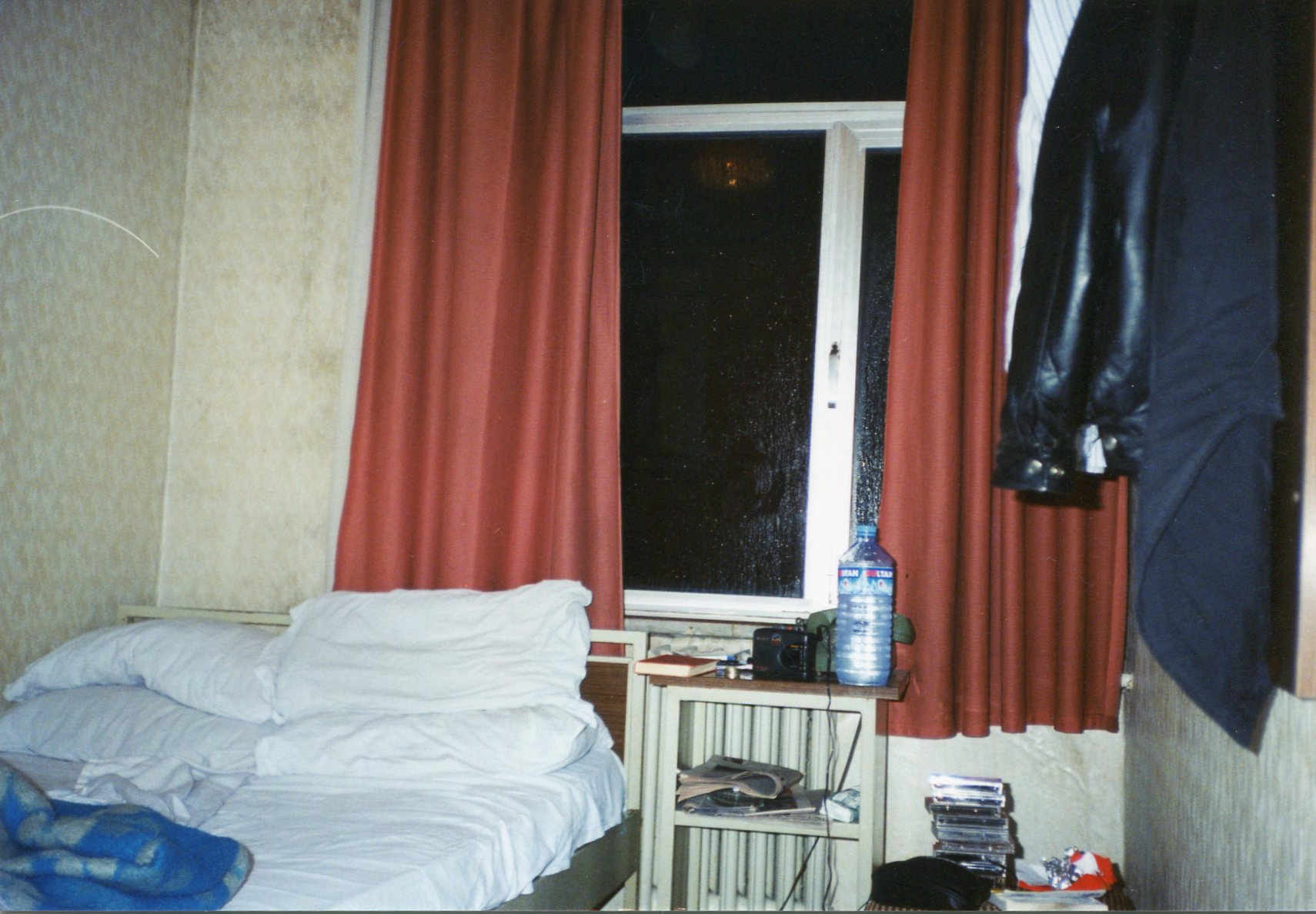
Postscript: a note and reminiscence on the picture. I generally try to use pictures from my travels in Turkey that have some tangential (and not always obvious) connection to the text. That may be true of this picture too, but it is also a small nostalgic reflection on fondly remembered friendly cheap workers’ hotels that could be found in Sirkeci in the 1980s and early 1990s. Now sadly replaced by poorly gilded (and much more expensive) tourist hotels. This was a room in one of my favourites, the original (and long departed) Otel Fahri on İbni Kemal Cad. when it was a quiet street (photo taken in early 1995). On one occasion, perhaps the time this photo was taken, there was a night time tavern restaurant around the corner squeezed in on Ebussuut Cad. near the corner of Ankara Cad. where gypsy musicians from Şişli would pass through – with much jolity, bonhomie and much drinking of rakı. When I visited the following year the tavern was gone, without trace (like something out of Robert Irwin’s Arabian Nightmare – but that is another story)  and Necmettin Erbakan was Prime Minister. I am not necessarily drawing a connection, but the belly dancer on the İbo Şov – Tatlıses is the great ‘Vicar of Bray’ of Turkish culture – also disappeared at this time, as I recall. The eagle-eyed will notice some travelling essentials in the picture – bottle of water (none other than ‘Sultan Su’), chocolate, cassette walkman – remember those! – leather jacket, tissues and book which, if  I must own up, was an old edition of John Buchan’s Greenmantle that, as is my practice, I donated to a hotel draw somewhere down the track in eastern Turkey).

Latife Bacı: Mey içtim sarhoşum bugün

Translation: Paul Koerbin

Today I drank wine and was drunk

I swear, I cannot hold my tongue

Today I was so pleased with my Dervish

I swear, I forgot all about death

The world appears completely empty

My Dervish brings me pleasure

He is exuberant whenever he loves

I swear, I love my Dervish

The morsel the Dervish proffers is permitted for me

The tavern is my pilgrim’s kabaa

The barking of the patrolling hounds

I swear, does not block my way

Let the Dervish come and be cross with me

Let my arm embrace his neck

Let the arms that are drawn away be broken

I swear, I cannot withdraw my arm

If I enter his embrace uncovered

If he sleeps and I love silently

If he awakes and he speaks rudely

I swear, I cannot withdraw my hand

I am Latife I am so shameless

I love greatly and I am so brazen

I know nothing of shame and honour

I swear, I will pluck my rose

———————————————————————————————–

Original Turkish text from Melûli divanı ve Aleviliğin tasavvufun Bektaşiliğin tarihçesi by Latife Özpolat and Hamdullah Erbil (2006)

Mey içtim sarhoşum bugün

Tutamam dilim vallahi

Pir’imle çok hoşuma bugün

Unuttum ölüm vallahi

Dünya tümden boş geliyor

Pir’im bana hoş geliyor

Her sevdikçe cüş geliyor

Severim Pir’im vallahi

Helal bana Pir lokması

Hacc-ı kâbem meyhanesi

Kelb rakibin ürümesi

Kesemez yolum vallahi

Varsın banan Pir darılsın

Kolum boynuna sarılsın

Çözülen kollar kırılsın

Çözemem kolum vallahi

Girsem koynuna gömleksiz

Uyusa ben sevsen sessiz

Uyansa dese edepsiz

Çekemem elim vallahi

Latife’m çok hayâsızım

Çok severim çok yüzsüzüm

Ar namus yok habersizim

Çalarım gülüm vallahi

Blog at WordPress.com.

  • Subscribe Subscribed
    • PİR SULTAN ABDAL and me
    • Already have a WordPress.com account? Log in now.
    • PİR SULTAN ABDAL and me
    • Subscribe Subscribed
    • Sign up
    • Log in
    • Report this content
    • View site in Reader
    • Manage subscriptions
    • Collapse this bar
 

Loading Comments...