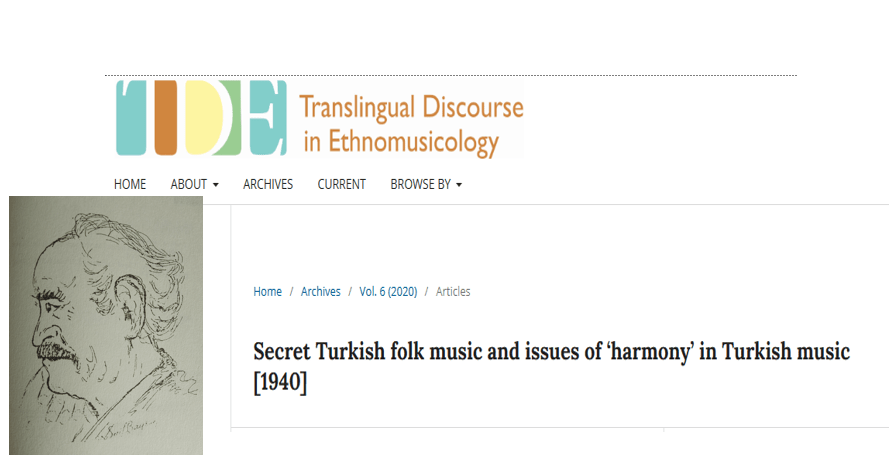
In the 1940s the Bektaşi poet, musician and scholar Vahid Lütfi Salcı published two short seminal monographs on Alevi music and culture. In 1940 he published Gizli Türk halk musikisi ve Türk musikisinde (armoni) meseleri (Secret Turkish folk music and the issues of ‘harmony’ in Turkish music) and in 1941 Gizli Türk dini oyunlar (Secret Turkish religious dances). In 2020 I published a translation of the first of the monographs in the journal Translingual Discourse in Ethnomusicology. That journal, which sadly now seems to have ceased publishing new issues, was a wonderful initiative of the Department of Musicology at the University of Vienna, aimed at encouraging discourse across language barriers by publishing English translations of important ethnomusicological works published in other languages and which may not have received as wide attention as desirable.
The work by Vahid Dede is important in many ways, not least for establishing the concept of Alevi music as a ‘secret’ or ‘hidden’ (gizli) part of Turkish folk music. It was the first substantial publication to focus on Alevi music per se and is all the more important since Vahid Dede was himself a Bektaşi and therefore writing with something of the authority of an ‘insider’. The work also aims to address what Vahid Dede refers to as misinterpretations of some earlier works of his – therefore this longer work to set the record straight. He argues that the music of the Bektaşi lodges has been corrupted by a “syrupy” urban, oriental style, particularly that as promulgated by Mehmet Hilmi Dede Baba; while the lost noble and dignified musical and performance character is still discernable in Alevi folk music. The publication includes musical examples and lyric examples from a number of poets including Harabi and Seyrani; and two lyrics from Pir Sultan Abdal (Gel güzelim kaçma bizden and Gelmiş iken bir habercik sorayım).
My translation and Vahid Dede’s original text are available in Volume 6 (2020) at the Translingual Discourse in Ethnomusicology website.
Meanwhile, I will include below my short “translator’s note” from the publication.
Translator’s note
At the beginning of the 1940s, the Istanbul-born poet, musician, teacher and scholar
Vahid Lütfi Salcı (1883-1950) published two monographs on Alevi music and
mystical dance (semah) – no more than short pamphlets – the first such monographs
in republican Turkey. The earlier of those two monographs is presented here in
English translation. Salcı’s studies promoted the concept of Alevi musical culture as
Turkey’s ‘secret’ folk music, although they were not in fact the first works to do so.
Salcı himself published several articles in the 1930s on Turkish folk music and Alevi
culture, including a substantial study in 1938 in the journal Ülkü Halkevi Dergisi
titled ‘Gizli Halk Musikisi’ (‘The Secret Folk Music’). Prior to this, the French
musicologist Eugene Borrel in 1934 published a paper in the Revue des
Études islamiques titled ‘Sur la musique secrète des tribus Turques Alévi’ presenting
similar conclusions (and in some parts similar descriptions) to Salcı’s later work. As
Borrel acknowledged, his work was largely influenced by materials supplied to him
by Salcı and by what he described as ‘un sensationnel article’ – referring to Salcı’s
series of articles on polyphonic folksong and harmony in folk music, published in
1933 in Milli Mecmua. Being Bektashi – he was also known as Vahid Dede – and
growing up with a forthright Alevi mother who rejected the offer for her son to study
as a hafiz (his father died when he was young), Salcı was well placed to gain access to
the secret rituals of Alevis and Bektashis as he travelled widely throughout Anatolia
and subsequently lived and worked in Thracian Turkey, particularly around Kırklareli.
As Salcı makes very clear in the work presented here, his purpose in publishing the
monograph is in no small part polemical. Firstly, it was to set the record straight
regarding ‘secret folk music’ and the issue of harmony in Turkish music, identifying
misinterpretations of his earlier works by those unqualified or without access to
materials. Secondly, it was a cri de coeur from the era of the newly established
Turkish Republic and following the period of Turkish language reform for the need to
abandon Ottoman music – which he recognised as beloved but also as a hindrance to
the young republic’s progress, reputation and place in the western world – in favour
of Turkish folk culture, particularly the pure expression of it found in the secret music
of Turkish Alevi tribal groups. In this context, Salcı calls for systematic action in
collecting folk material generally, especially the secret music culture of village
Alevis. The study itself is frequently rhetorical, with excursions into the description of
ritual (specifically that of the sofra feast and communal muhabbet gatherings); it also
presents some musical and textual materials, including examples from at least ten
lyric poems, together with some rather perfunctory analysis. In keeping with the
rhetorical purpose of the study, the language moves from the succinct and imperative
to the lyrical and prolix, providing significant challenges for the translator – a task not
helped by a number of printing and typographical errors in the original.
Paul Koerbin
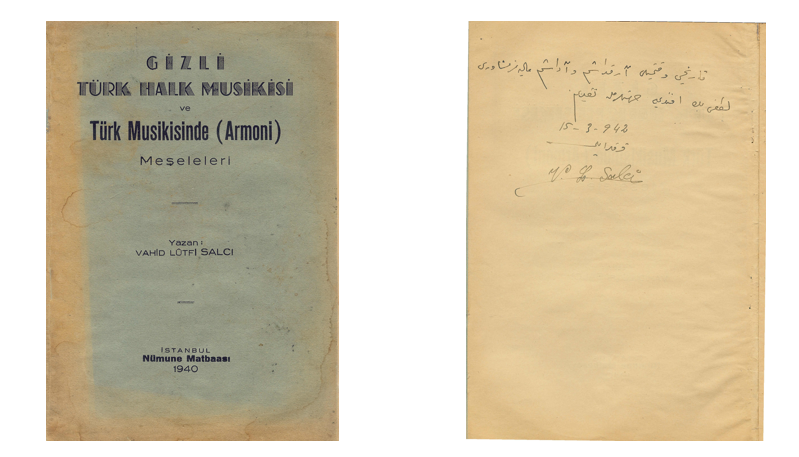
The original 1940 publication and autograph by Vahid Lütfi Salcı (from my personal collection).
The sketch of Vahid Dede included in the image at the top of the post is taken from the book Vahit Lütfi Salcı’nın izinde by Mevlüt Yaprak (Ulusal: Edirne, 2003).
 PİR SULTAN ABDAL and me